
Project management
The project manager at CRAL acts as the coordinator of project activities; in particular, they will:

The project manager at CRAL acts as the coordinator of project activities; specifically, they will:
- Serve as the project’s technical lead
- Coordinate scientific, optical, mechanical, electronic, and software activities
- Define the project’s objectives:
- Performance and functionalities required for scientific research
- Total cost of the instrument
- Instrument commissioning date
- Lead and coordinate the project team at CRAL
- Serve as the technical liaison with other partner laboratories and industrial partners
- Establish and monitor a project progress schedule
- Manage the project budget
- Identify and monitor project risks
- Ensure the quality of the institute’s deliverables
- Communicate about the project both internally and to the general public
A project at CRAL is an initiative launched with the goal of delivering a unique product that meets the stated requirements within a defined timeframe and budget.
At CRAL, projects are most often instruments used for observations in the field of astrophysics and are installed on the largest telescopes around the world. Each instrument is unique in its requirements, performance, and use.
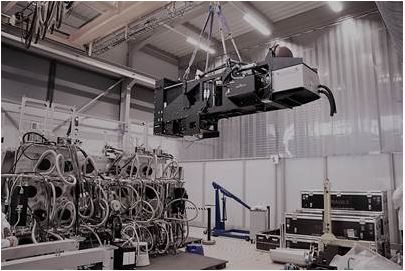
Integration of the MUSE Beam Extension at CRAL

Depending on its size and complexity, a project at CRAL will last between 8 and 12 years, from the preliminary study phase through commissioning and the first observations.

Instrumental projects are developed in partnership with other research laboratories in France and around the world. Forming a consortium allows for the sharing of effort and resources among several countries and laboratories, thereby maximizing the chances of achieving the set objectives. The projects are also supported by numerous industrial partners who will manufacture and deliver components of the instrument.
A typical project team at CRAL consists of:
- Principal Investigator: The project initiator and scientific lead
- Project Manager: The technical lead of the project Systems Engineer: The lead for the instrument’s architecture and the interfaces between its various components
- Optical Expert
- Mechanical Expert
- Scientific Computing Expert
- The scientific team(s)