History and Heritage
The Lyon Astrophysics Research Center (CRAL) is a Joint Research Unit (UMR 5574) established in 1995 under the joint supervision of the National Center for Scientific Research (CNRS), Claude Bernard University Lyon 1 (UCBL), and the École Normale Supérieure (ENS) of Lyon. Like its sponsoring organizations, CRAL is part of the University of Lyon (UdL) Community of Universities and Institutions (COMUE),
The CRAL is located at two sites:
- the Lyon Observatory in Saint-Genis-Laval,
- the Monod Campus of the ENS Lyon, in Lyon’s 7th arrondissement.
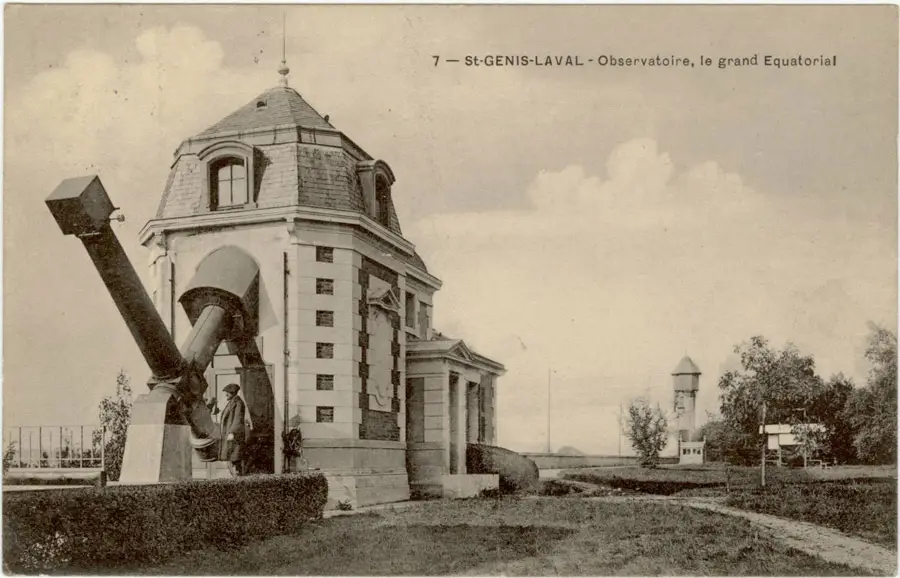
The Lyon Observatory was founded on March 11, 1878 (by a decree signed by French President Patrice de Mac Mahon) with astronomer Charles André (1842–1912) serving as its first director until 1912; its management was entrusted to the State, the City of Lyon, and the Rhône Department. It is situated on 4 hectares of land in the municipality of Saint-Genis-Laval. Its 350mm equatorial refractor telescope under a rolling shelter has been a listed historic monument since April 21, 2008; its purpose was to allow observation of the sky without having to move the telescope. The Observatory is part of France’s astronomical heritage and is one of the first observatories established in France, alongside those in Paris (1667), Marseille (1863), Toulouse (1872), Bordeaux (1878), and Besançon (1878).
In its early days, the Observatory served both astronomical and meteorological purposes, providing time-keeping services for the City of Lyon and issuing weather reports, alongside observations of celestial objects (stars, planets, etc.). Meteorological activities gave way to astronomical observations from the 1920s through the 1940s with the development of spectroscopy and photometry.
Since then, observation activities at the site have been aimed at the general public; professional astronomical observations have been conducted for several decades at high-quality sites free from light pollution and with favorable weather conditions, or even directly from space.
In 2008, the site acquired a new building, the construction of which was funded by the City of Saint-Genis-Laval, Greater Lyon, the Region, the Department, and the City of Lyon. Among other things, this building houses a state-of-the-art instrument platform, where the MUSE instrument for the Very Large Telescope (VLT) of the European Southern Observatory (ESO) in Chile was integrated and tested.
The ENS Lyon was established on January 1, 2010 (with a new decree on May 8, 2012). The ENS Lyon is one of four ENS institutions in France, alongside the ENS Ulm (1826), ENS Paris-Saclay (1912), and ENS Rennes (2013). It is the result of the reorganization and decentralization of the ENS institutions.
The scientific ENS Lyon was inaugurated in 1986 and began operations in 1987—the result of the relocation of the scientific section of the ENS Saint-Cloud (founded in 1882, originally a school for boys). As early as 1993, an astrophysics group was formed within the school, focused on theoretical studies. The literary section of the ENS in Fontenay-aux-Roses (founded in 1880, originally a school for girls)—Saint-Cloud also moved to Lyon in 2000 (ENS-LSH, Letters and Humanities). The two schools merged to form the ENS de Lyon, located respectively on the Monod and Descartes campuses in Lyon’s 7th arrondissement in the Gerland district.
In 1995, astrophysics activities at the Lyon Observatory and the ENS de Lyon Scientific (later ENS de Lyon in 2010) were consolidated into a single Joint Research Unit, a standard research structure in France, the CRAL – UMR5574. Prior to January 1, 2007, CRAL stood for the Lyon Astronomical Research Center; since then, it has been the Lyon Astrophysical Research Center.