ASTROENS
Research Areas
- Fundamental physics, equations of state, turbulence
- Stellar interiors
- Planetary and stellar formation
- Galaxy formation and evolution
- Numerical astrophysics, development of new numerical methods
- Theoretical, mathematical, and observational cosmology

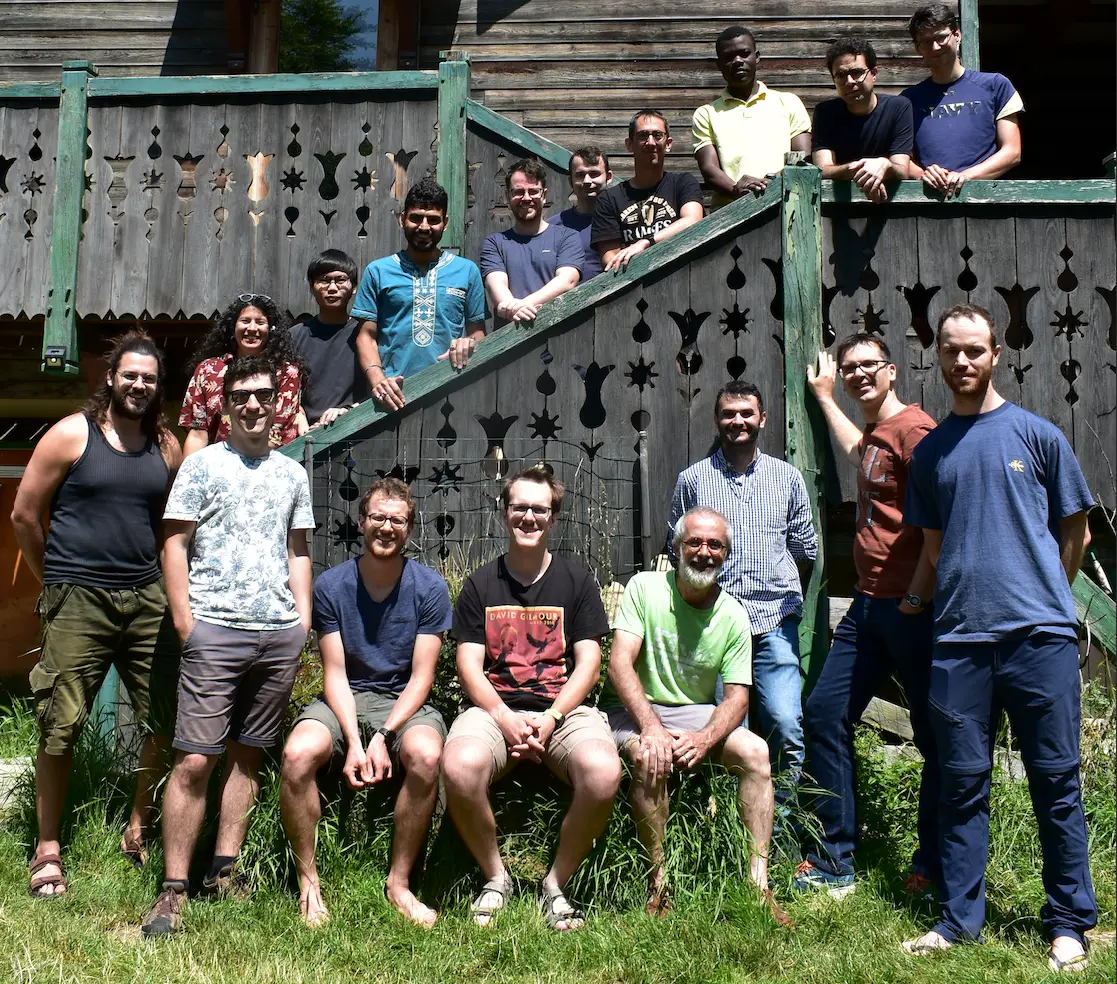
Researchers
- Guillaume LAIBE, team leader
- Isabelle BARAFFE (on secondment, University of Exeter, UK)
- Thomas BUCHERT
- Gilles CHABRIER (CNRS Emeritus Researcher)
- Benoît COMMERÇON
- Jérémy FENSCH
- Jean-François GONZALEZ, Director of CRAL
- Gérard MASSACRIER
- Rolf WALDER (Professor Emeritus, ENS)
- Christophe WINISDOERFFER
Associate Researchers
- Doris FOLINI (ETH Zurich, Switzerland)
- Sacha POTEKHIN (Ioffe Institute, St. Petersburg, RU)
- Quentin VIGNERON (Postdoctoral Fellow, Nicolaus Copernicus University, Torun, PL)
Postdoctoral researchers
- Adnan Ali AHMAD
- Hamed BARZEGAR
- Noé BRUCY
- Tine COLMAN
- Elliot LYNCH
- Anass Serhani
- David WHITWORTH
Doctoral students
- Antonin BORDERIES
- Pierre DUMOND
- Yona LAPEYRE
- Louca ROMAIN
- Nai-Chieh “Daniel” LIN
- Léodasce Sewanou
Current projects

(ERC Consolidator, PI: LAIBE)
The PODCAST project is funded by an ERC Consolidator Grant and is led by Guillaume Laibe. The project addresses one of the fundamental questions of modern astrophysics: How do planets form? It all starts with dust grains a few micrometers in size that must grow by more than 30 orders of magnitude in mass to form planets. Thus, comprehensive simulations of dust grain evolution—including the dynamics of these particles, their growth and fragmentation, and radiation within the disk—are essential to understanding this process. To date, such models have not yet been developed due to the immense difficulties encountered in understanding the fundamental physical properties of dust fluids. The evolution of dust grain distributions in protoplanetary disks therefore remains poorly understood. Thanks to our numerical model, which for the first time incorporates non-ideal MHD processes, radiation transport, and dust grain evolution (dynamic growth/fragmentation), we can overcome these difficulties and consistently model the evolution of the gas-dust mixture in the disks. PODCAST aims to study the different stages of gas and dust evolution in the disks, while combining these different stages into a holistic model for planet formation. We will directly compare our results with observations to take advantage of the large-scale instruments ALMA, SPHERE, JWST, and SKA.
(ERC Advanced Grant, PI: BUCHERT)
http://www.arthus-erc.net/cosmo_fr.html
The ARThUs project (Advances in Theoretical Research on the Dark Universe) is funded by an ERC Advanced Grant and is led by Thomas Buchert. The project explores two main directions:
– study of the effects of inhomogeneities in relativistic cosmology on the average properties of a cosmological model. We ask whether these inhomogeneity effects, being quantitatively significant, could even resolve the dark energy and dark matter problems of the standard model of cosmology.
– robust morphological analysis of galaxy catalogs and cosmic microwave background (CMB) data, using tools from integral geometry (Minkowski functionals) and topological tools (homology).
(ANR, co-PI: COMMERCON)
The DISKBUILD project is a collaborative research project funded by the ANR and led by Benoît Commerçon at CRAL (Coordinator: Sébastien Charnoz at IPGP). Planets form in a protoplanetary disk (PPD) around a protostar. Numerous data suggest that accretion processes begin during the cloud’s collapse, lasting from 100,000 to 1 million years. However, most work on planetary formation still operates within the paradigm of an isolated disk. Thus, our goal is to study the inflow of material into a PPD, to investigate how it modifies the disk’s evolution, dust transport, and the formation of planetary bodies. Our project brings together three teams from various fields (star formation, planet formation, and cosmochemistry) to study (1) the thermal structure of the disk and the cloud flow (2) dust transport and diffusion within the disk (3) where and when planetesimals form (4) and the migration of planets within these disks. This will provide a new framework for interpreting meteorite data and understanding planetary formation, and will bridge the gap between planets and the interstellar medium.

(ANR, co-PI: COMMERCON)
https://promethee-anr.github.io
PROMETHEE is funded by the ANR for the period 2023–2026. PROMETHEE is a joint CNRS project involving the Grenoble Institute of Planetology and Astrophysics (IPAG, PI Alecian, Co-PI Dougados), the Lyon Astrophysics Research Center (CRAL, Co-PI Commerçon), and the Laboratory for the Study of Radiation from Matter in Astrophysics and Atmospheres (LERMA, Co-PI Petitdemange). The problems of angular momentum and magnetic flux have been intensively studied for two of the three main phases of star formation: the core collapse (CC) phase in molecular clouds and the pre-main sequence (PMS) phase. To extract just enough—but not too much—magnetic flux and angular momentum, several processes interact: turbulence, radiation, rotation, and the magnetic field. Fundamental questions, however, remain unanswered. In particular, the intermediate protostellar phase has been little studied, and integrated models of magnetic protostars are notably absent. The protostellar phase is fundamental to determining the future of a stellar system. During this phase, the star grows and accretes most of its mass, powerful outflowing jets and outflows are launched, dynamo processes begin to generate magnetic fields, the star sheds its natal envelope, a large majority of its angular momentum is extracted, and the protoplanetary disk forms and begins to build planetary embryos. The question of how a newly formed magnetic protostar evolves over approximately 1 million years before emerging from its dusty cocoon, and how its magnetic field is involved in the long-standing problem of accretion/ejection in protostars, remains open. PROMETHEE will address these issues by measuring, for the first time, the magnetic and magnetospheric properties of protostars, and by constructing a theoretically and observationally consistent MHD model of a young magnetic protostar.
(EuroHPC, PI: COMMERCON)
The SPACE Center of Excellence is funded by EuroHPC for the period 2023–2026. The project is led by the University of Turin (PI Mignone) and at CRAL by Benoît Commerçon (CoI). In the field of astrophysics and cosmology (A&C), numerical simulations based on high-performance computing (HPC) are now exceptional tools for scientific discovery. They are essential tools capable of studying, interpreting, and understanding the physical processes underlying the observed sky. For these tools, the effective utilization of exascale computing capabilities is essential. However, exascale systems are expected to exhibit unprecedented heterogeneous architectural complexity, which will have a significant impact on simulation codes. This is why the SPACE Center of Excellence aims to thoroughly redesign target codes to adapt them to new computing solutions and adopt innovative programming paradigms, software solutions, and libraries. SPACE aims to promote the reuse and sharing of algorithms and software components in the field of A&C applications, achieving this through co-design activities that bring together scientists, code developers, HPC experts, hardware manufacturers, and software developers, advancing flagship exascale A&C applications, codes, services, and know-how by promoting the use of upcoming exascale and post-exascale computing capabilities. SPACE will focus on the high-performance analysis of the data deluge produced by exascale A&C simulation applications, including through the use of machine learning and visualization tools. The deployment of applications running on different platforms will be facilitated by federated capabilities focused on code repositories and data sharing, and by integrating European astrophysics communities around exascale computing through the adoption of interoperability standards and protocols for software and data.
(PEPR, co-PI: COMMERCON)
MHD@EXASCALE is funded under the PEPR ORIGINES program. The MHD@Exascale project aims to develop a new generation of magnetohydrodynamic simulation codes capable of efficiently utilizing new accelerated supercomputers, such as the future Exascale machine to be installed at the CEA’s Very Large Computing Center (TGCC) in 2025–2026. The project aims to develop two complementary simulation codes and a platform for sharing simulation data that is open to the community. These tools will enable ab initio simulation of the collapse of interstellar clouds through to the formation of primordial planetesimals, while capturing the coupling with magnetic fields, dust, and radiation in real time at temporal and spatial scales unexplored until now. Furthermore, the project aims to reduce the environmental impact of the simulations by minimizing their energy footprint and maximizing the sharing of raw data for reuse in other projects.
(ERC RISE, PI: LAIBE)
DUSTBUSTERS is funded by an ERC RISE project and led by Guillaume Laibe at CRAL. DUSTBUSTERS fosters collaboration between CRAL researchers and institutions around the world.
(ANR, Principal Investigator: FENSCH)
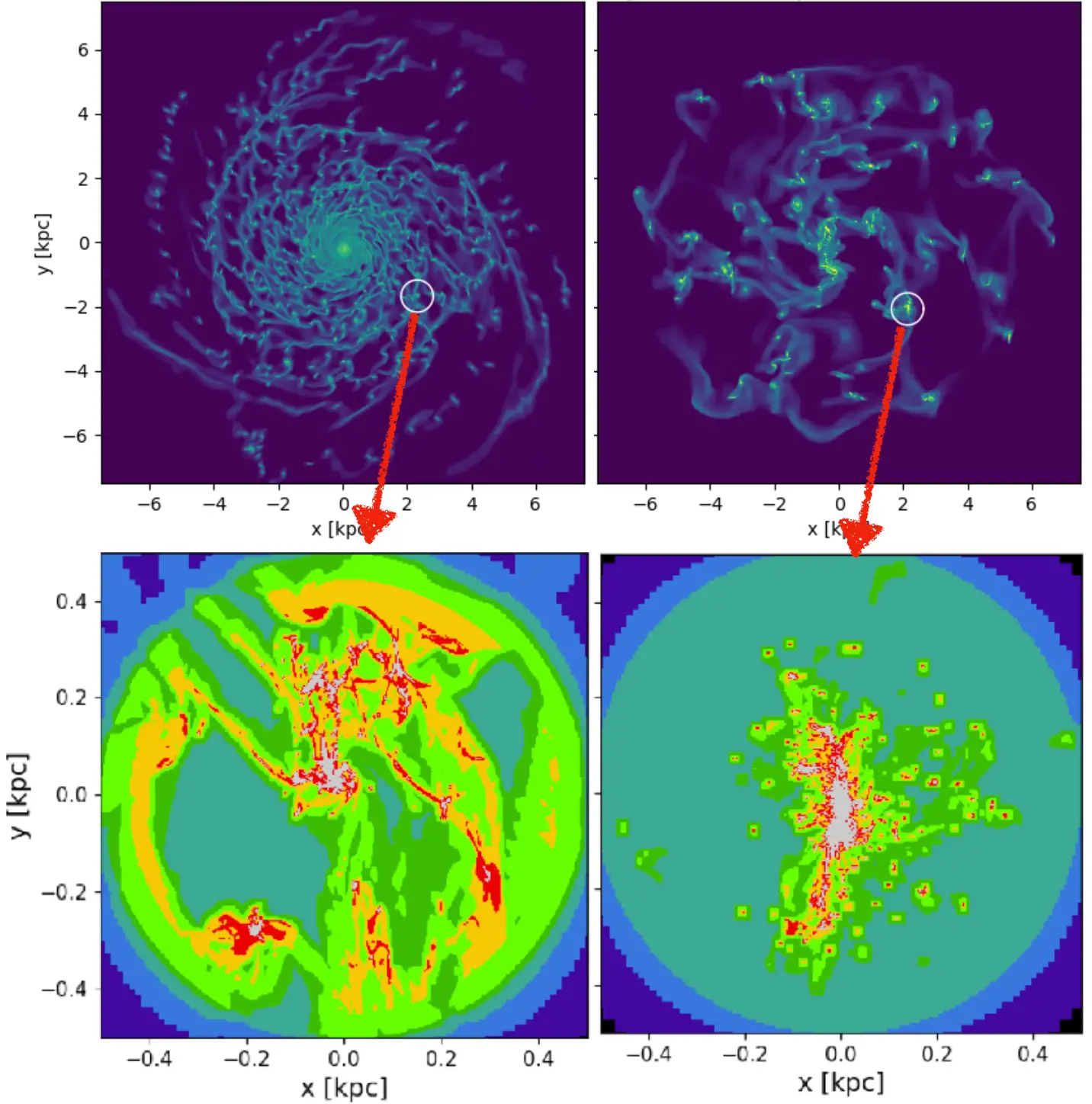
This project, funded by the ANR JCJC program, aims to use a new numerical method to combine the scales governing star formation in galaxies—namely, the galactic scales at which turbulence is injected, and the sub-parsec scales where the feedback energy from star formation is injected.
(ANR, co-PI: FENSCH)
The DARK project is led by N. Bouché (CRAL) and J. Fensch and aims to study the dark matter content of galaxies at a redshift of ~1, observed by the MUSE instrument on the VLT. It proposes using a new method to resolve the degeneracy between the contributions of the dark matter halo and the stellar disk in order to determine the dark matter content and its evolution from [OII] emission line spectro-imaging data.
News
-
10 April 2026
Armand Leclerc Wins the MERAC Award for Best Thesis
-
4 March 2026
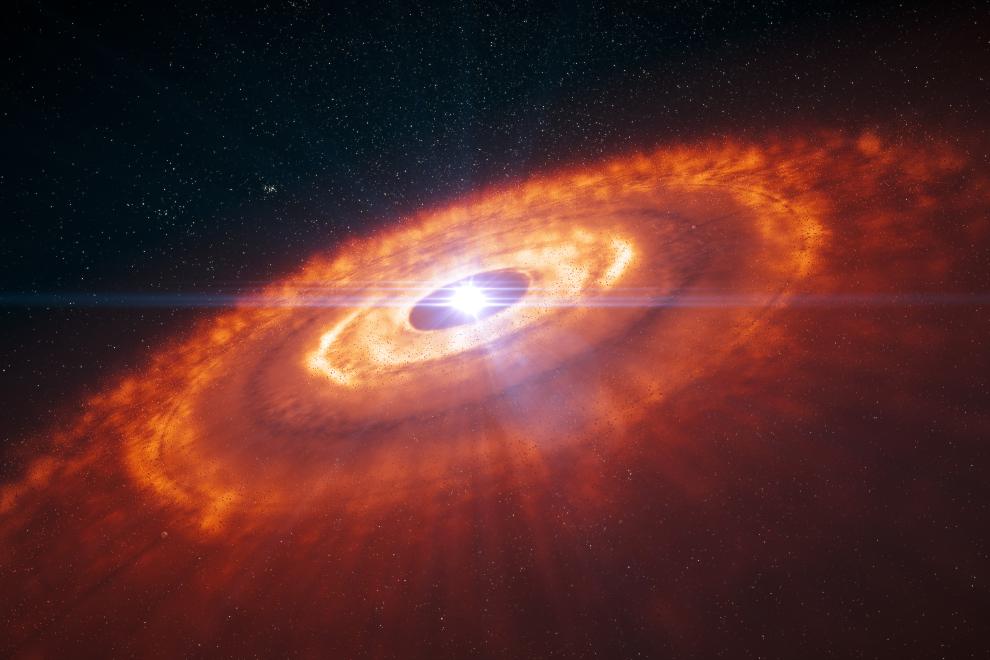
New simulations are refining our understanding of the factors that govern planet formation
-
6 November 2025
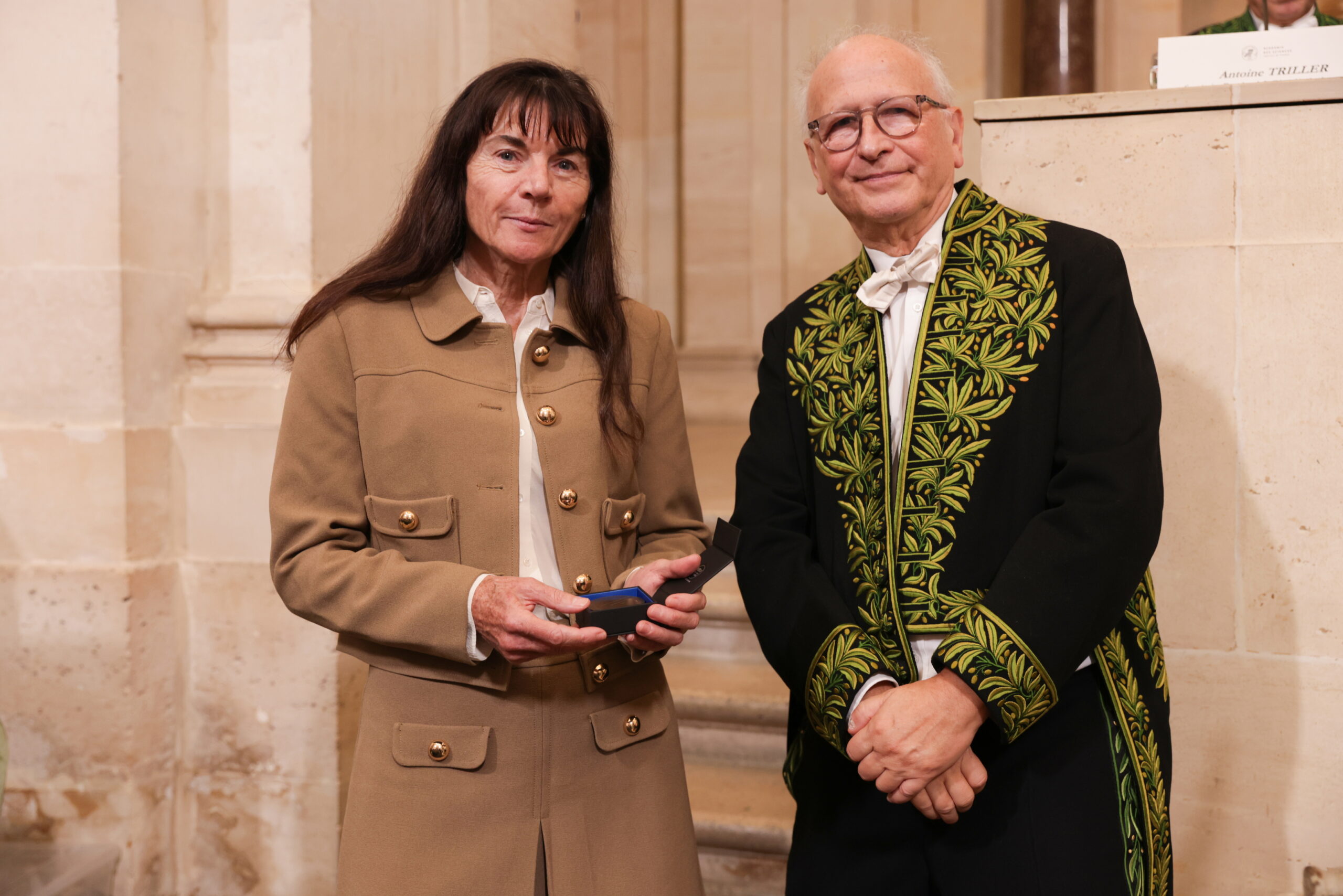
Isabelle Baraffe receives the Academy of Sciences’ Prize in Space Sciences
-

22 January 2025
Thomas Buchert Receives the Levi-Civita Prize
-
26 September 2024
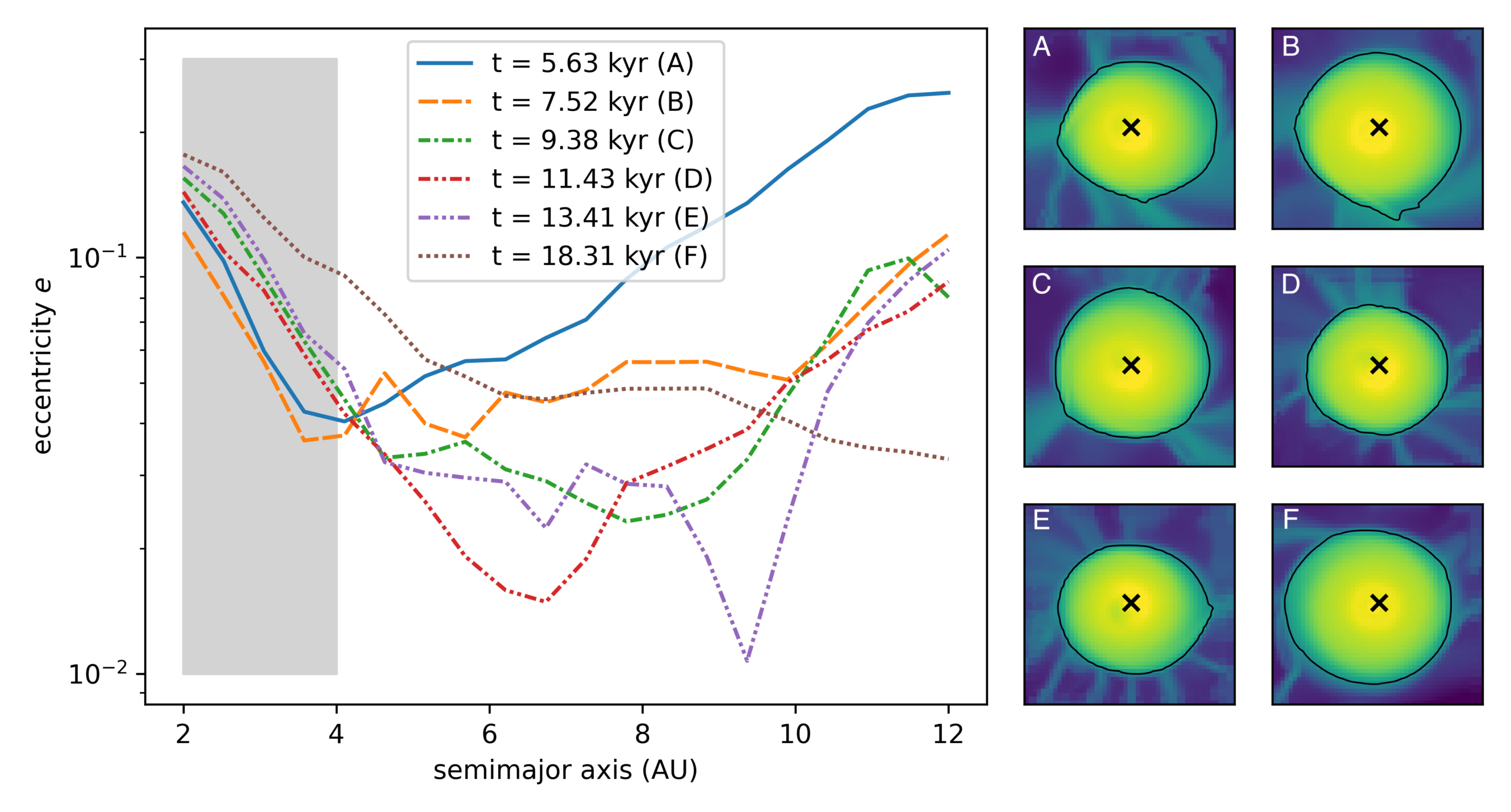
Discs are born off-center
-
26 September 2024
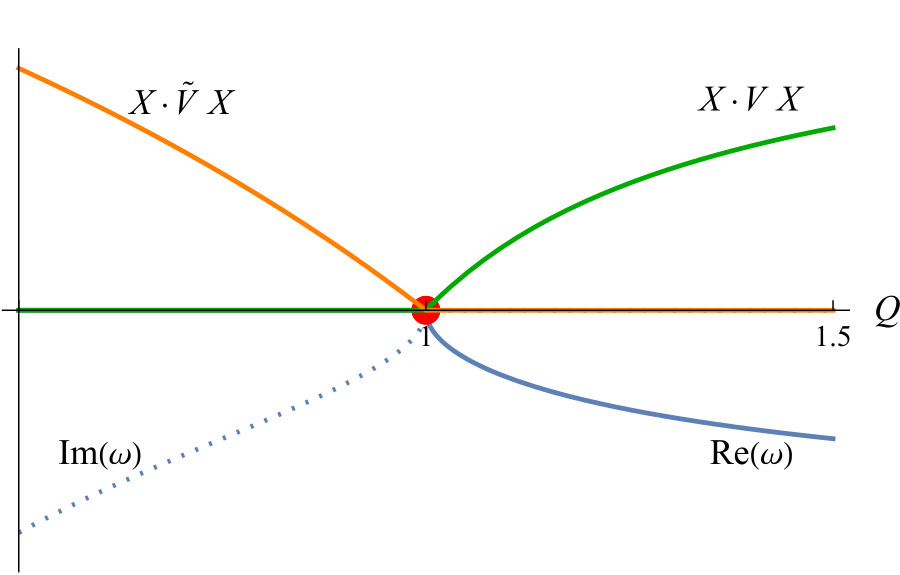
PT and anti-PT symmetries for astrophysical waves