Seminar by Arif Babul (University of Vancouver)
The Formation and Evolution of Massive Galaxies in the Cosmos and Their Circumgalactic Environment.
Abstract
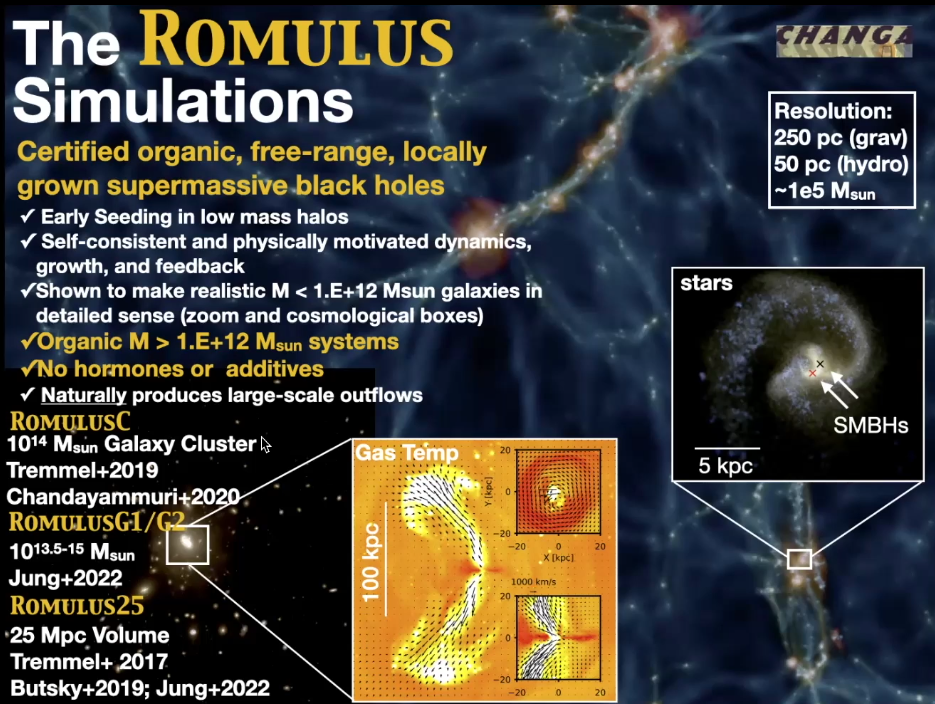
Contrary to many stereotypes about massive galaxies, the observed systems exhibit a wide range of star formation rates, kinematic properties, and morphologies. Studying how they evolve to exhibit such diverse characteristics is a crucial piece of the galaxy formation puzzle. Here, we focus on a subset of massive galaxies: the brightest group galaxies (BGGs). We use a high-resolution cosmological suite of simulations based on the Romulus galaxy formation model and compare simulated central galaxies in group-scale halos at z=0 with their observed counterparts. Since most galaxy formation models are calibrated using measures that are strongly influenced by the properties and evolution of “normal” Milky Way-like galaxies, this exercise also provides an opportunity to test the limits of these models. The comparison encompasses the stellar mass–halo mass relation, various kinematic properties and scaling relations, morphologies, and star formation rates. We find Romulus BGGs that are early-type S0 and elliptical galaxies as well as late-type disk galaxies; we find BGGs that are fast-rotating as well as slow-rotating; and we observe BGGs transforming from late-type to early-type following strong dynamical interactions with satellites.