Astronomers have produced the most detailed multicolor image of a galaxy ever obtained
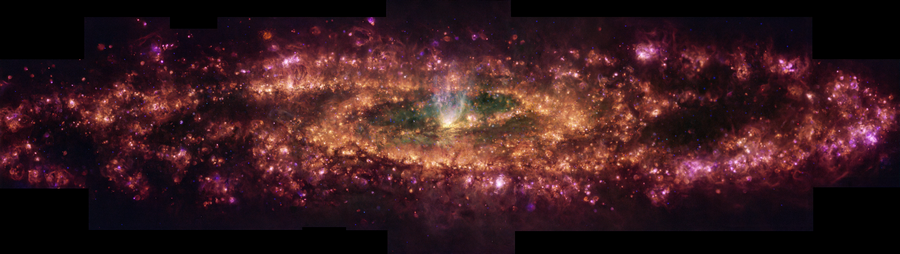
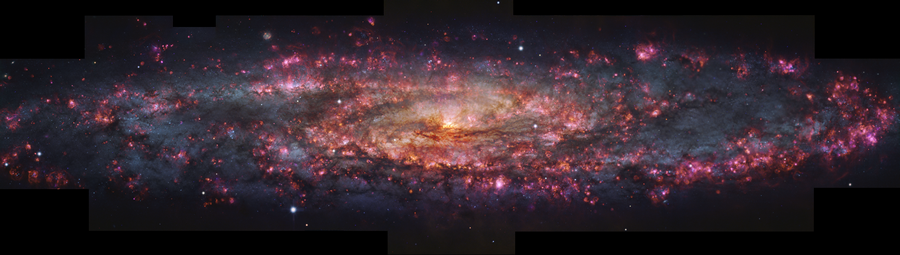
A team of astronomers—including Éric Emsellem of CRAL, who is on secondment to ESO—has created a galactic masterpiece: an ultra-detailed image that reveals previously unseen features of the Sculptor Galaxy. Using the MUSE instrument, designed at the Lyon Observatory and now installed on ESO’s VLT, they observed this nearby galaxy in thousands of colors simultaneously. By capturing large amounts of data at each location, they created a snapshot of the life of stars on the scale of the entire Sculptor Galaxy.
Credit: ESO / E. Congiu et al.
“Galaxies are incredibly complex systems that we still struggle to understand,” explains Enrico Congiu, a researcher at ESO, who led a new study published in Astronomy & Astrophysics on the Sculptor Galaxy. Reaching hundreds of thousands of light-years in diameter, galaxies are extremely large, but their evolution depends on what happens on much smaller scales. “The Sculptor Galaxy is in an ideal location,” explains Enrico Congiu. “It is close enough that we can resolve its internal structure and study its constituent elements in incredible detail, but at the same time, it is large enough that we can view it as a complete system.”
The building blocks of a galaxy—stars, gas, and dust—emit light of different colors. Consequently, the more color nuances there are in an image of a galaxy, the more we can learn about its inner workings. While conventional images contain only a handful of colors, this new map of the Sculptor Galaxy includes thousands. As a result, astronomers know everything they need to know about the stars, gas, and dust it contains, such as their age, composition, and motion.
To create this map of the Sculptor Galaxy, located 11 million light-years away and also known as NGC 253, researchers observed it for more than 50 hours using the MUSE (Multi Unit Spectroscopic Explorer) instrument on the European Southern Observatory’s (ESO) Very Large Telescope (VLT). The team had to combine more than 100 exposures to cover an area of the galaxy approximately 65,000 light-years wide.
Credit: ESO / E. Congiu et al.
According to Kathryn Kreckel of Heidelberg University in Germany, a co-author of the study, this makes the map a powerful tool: “We can zoom in to study specific regions where stars are forming on a scale close to that of individual stars, but we can also zoom out to study the galaxy as a whole.”
In its initial analysis of the data, the team discovered about 500 planetary nebulae—regions of gas and dust ejected by dying stars similar to the Sun—in the Sculptor Galaxy. Fabian Scheuermann, a doctoral student at Heidelberg University and co-author of the study, puts this figure into context: “Beyond our galactic neighborhood, we generally find fewer than 100 detections per galaxy.”
Because of their properties, planetary nebulae can be used as distance markers relative to the galaxies that host them. “ The discovery of planetary nebulae allows us to verify the distance between us and the galaxy, essential information on which other studies of the galaxy depend,” explains Adam Leroy, a professor at Ohio State University (United States) and co-author of the study.
Future projects using the map will explore how gas flows, changes its composition, and forms stars throughout the galaxy. “How such small processes can have such a significant impact on a galaxy that is thousands of times larger remains a mystery,” says Enrico Congiu.
- Find the full press release here on the ESO website, including scientific contacts and downloadable high-resolution images.
- Article reference: CONGIU, E.; SCHEUERMANN, F.; KRECKEL, K.; LEROY, A.; EMSELLEM, E.; BELFIORE, F.; HARTKE, J.; ANAND, G.; EGOROV, O. V.; GROVES, B.; KRAVTSOV, T.; THILKER, D.; TOVO, C.; BIGIEL, F.; BLANC, G. A.; BOLATTO, A. D.; CRONIN, S. A.; DALE, D. A.; McCLAIN, R.; MENDEZ-DELGADO, J. E.; OAKES, E. K.; KLESSEN, R. S.; SCHINNERER, E.; WILLIAMS, T. G.. The MUSE view of the Sculptor galaxy: survey overview and the planetary nebulae luminosity function. Astronomy & Astrophysics, 2025, 21p.
- The European Southern Observatory provides a tool on its website to view MUSE data cubes online. Find the one for NGC 253 by clicking here.
- ESO has also produced several short videos to present these new results: