Seminar by Seok-Jun Chang (MPIA Garching)
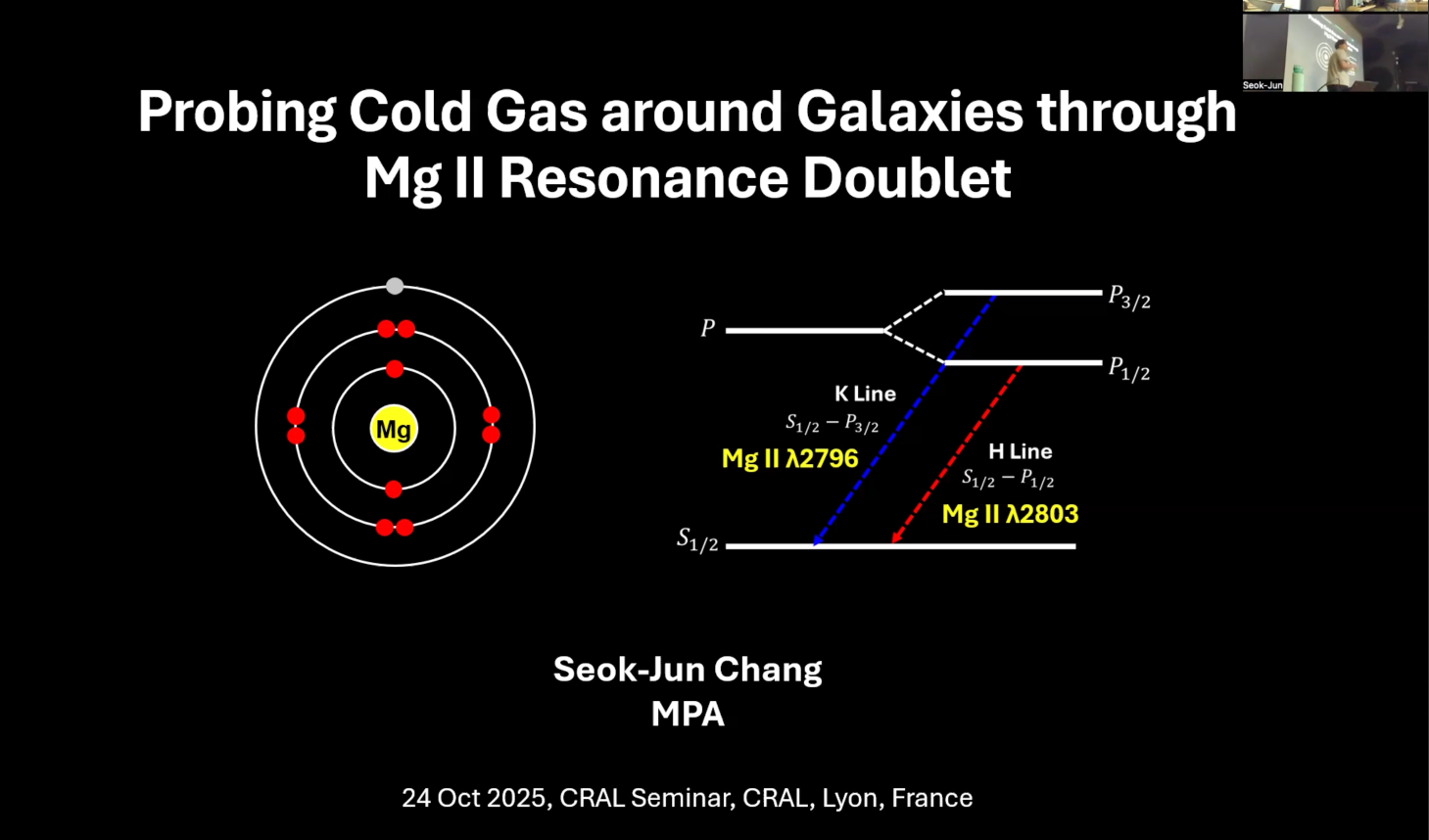
Investigating Cold Gas Around Galaxies Using the Mg II Resonance Doublet
Abstract
The structure and kinematics of the gas around and within galaxies are crucial for understanding the multiphase flows within the galactic ecosystem and, consequently, galaxy evolution and star formation. Recent advancements in instruments and techniques offer a new perspective on circumgalactic gas flows through emission lines such as Hydrogen Lyman-α and resonance lines of metals (e.g., Mg II, C IV, O VI, and N V). In particular, the Mg II 2796 Å, 2803 doublet has emerged as a promising tracer of cold gas at T ~ 10^4 K. To decode the message carried by the Mg II doublet emission, we developed a 3D Monte Carlo radiative transfer code ‘RT-scat’. In this talk, I will present simulated results from ‘RT-scat’, demonstrating how Mg II lines form in various environments, including inflowing and outflowing gas, smooth/clumpy gas, and dusty gas.
In particular, I will also highlight how the Mg II doublet line ratio can serve as a potential indicator of LyC escape. Furthermore, I will introduce our new radiative transfer modeling of Mg II emission halos around star-forming galaxies at z ~ 1 from the MAGG and MUDF surveys. Our results indicate the presence of slowly moving or outflowing cold gas and reveal strong anisotropies in its distribution. If time permits, I will also discuss other metal resonance lines as tracers of multiphase gas.