New simulations are refining our understanding of the factors that govern planet formation
The formation of planets—such as those in our solar system—begins in the vast disks of gas that surround young stars. It is the tiny dust grains present in these environments that, through collisions with one another, form centimeter-sized pebbles and then kilometer-sized planetesimals. Gravity then takes over, causing these planetesimals to coalesce into protoplanets. Until now, the mechanism by which pebbles transition into planetesimals was poorly understood, but new simulations highlight the role of several key factors.
To explain planet formation, the most promising hypothesis is that of flow instability, which allows pebbles to rapidly coalesce into planetesimals. However, this mechanism requires specific conditions to trigger, and astrophysicists did not know whether these conditions were actually present in protoplanetary disks.
New computer models have allowed researchers at the Lyon Astrophysics Research Center (CNRS, ENS de Lyon, University of Lyon 1) to verify these conditions and have highlighted the essential role of grain porosity, fragmentation, compaction, and the carbon monoxide (CO) freezing line in the formation of planetesimals.
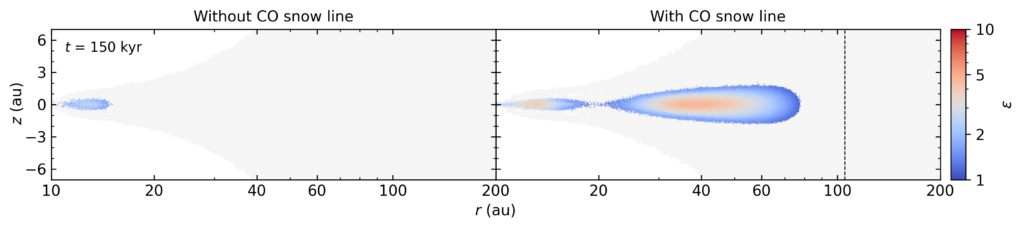
This line marks the boundary beyond which CO forms a layer of ice around dust grains, which affects the adhesion of the dust particles to one another. Closer to the star, CO is present in gaseous form. Without accounting for this parameter, the simulations show planetesimal formation occurring in a small portion of the disk, near the star. However, by adding the CO freeze line to the model parameters, the team obtained a large region where the dust-to-gas ratio is favorable for planetesimal formation (see figure).
Simulation of regions where the dust-to-gas ratio ε allows for planetesimal formation: on the left without accounting for the CO freezing line, and on the right, with it accounted for (dotted line). When present, it acts as a barrier that slowly feeds dust grains into the interior of the disk.