
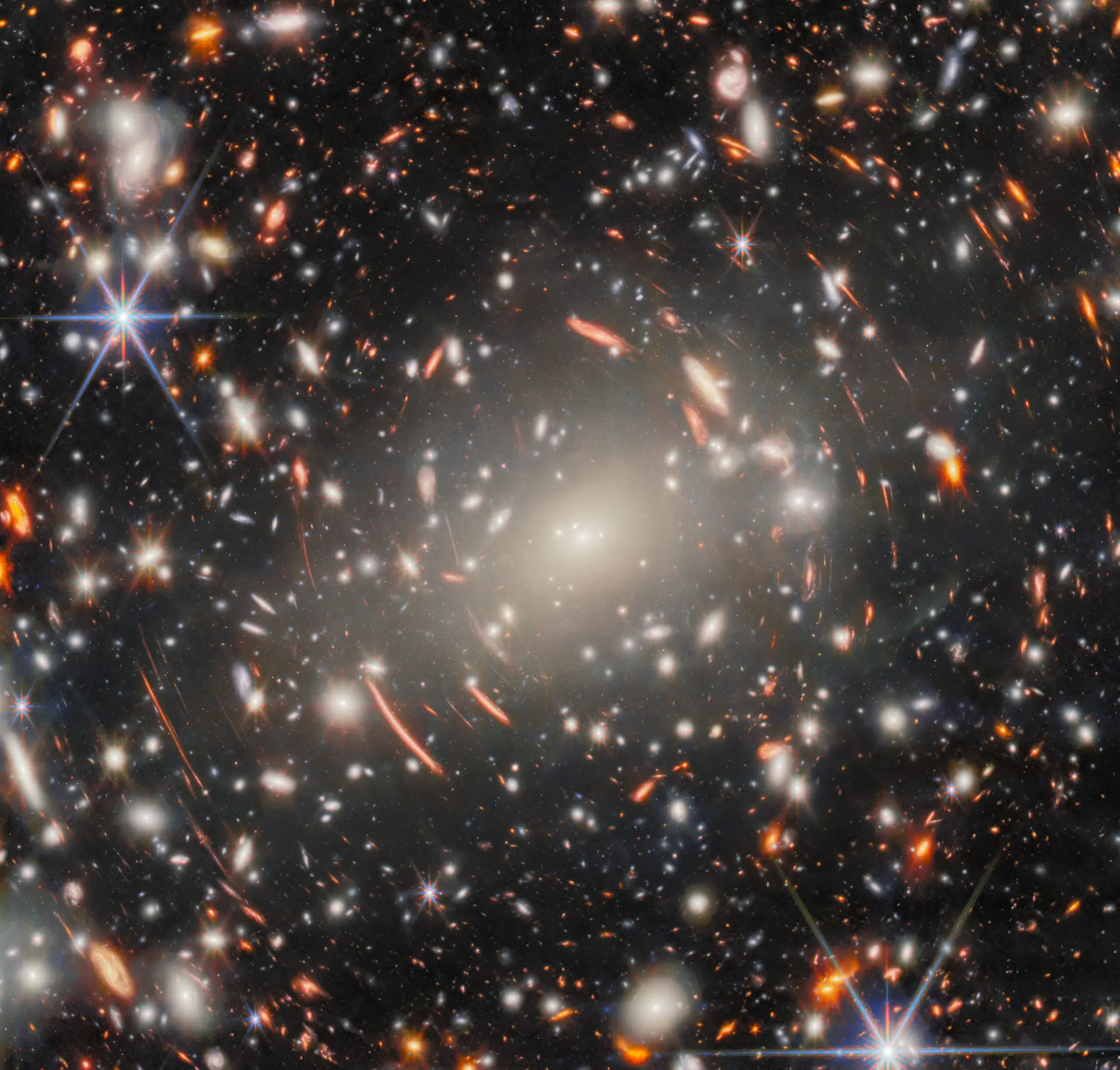
Researchers from CRAL contributed to capturing the deepest image of our universe as part of the James Webb Space Telescope’s GLIMPSE program. This observation was made possible by pointing the telescope at the Abell S1063 galaxy cluster, whose mass is so great that it bends and amplifies the light from galaxies located behind it. Among the extremely distant and ancient galaxies observed in this way is a candidate for potentially hosting Population III stars, the very first generation of stars in the Universe.
Credits: ESA/Webb, NASA & CSA, H. Atek, M. Zamani (ESA/Webb).
The deepest image of the Universe
The GLIMPSE observation program—in which Jérémy Blaizot, Adélaïde Claeyssens, Floriane Leclercq, Johan Richard, and Joki Rosdahl from CRAL—aims to observe the most distant flashes of light in our Universe and, given the finite speed of light, the oldest galaxies. Despite its extraordinary capabilities, the James Webb Space Telescope cannot, on its own, observe the most distant regions of the Universe. To do so, astronomers must take advantage of a natural physical phenomenon that acts as a natural “super telescope”: gravitational lensing. In space, very massive objects (such as galaxy clusters) can affect light passing nearby: its rays can be deflected, distorted, and sometimes… amplified. This is what the image above reveals: the Abell S1063 galaxy cluster (white galaxies) is so massive that it distorts the light from very distant galaxies in the background (red galaxies), forming large arcs that can, in places, create natural “zooms.” The Abell S1063 cluster is located 4.5 billion light-years away from us in the constellation Grus, but the galaxies it reveals are much older: they formed just 250 million years after the Big Bang.
Light from the Dark Ages
Studying the most distant galaxies possible is essential to understanding the formation and evolution of the first populations of stars that led to the current Universe we can observe locally. When the most distant galaxies observed by the JWST formed, the Universe was emerging from a period known as the “dark ages,” at the time of the formation of the first stars. This first generation of stars, known as “Population III stars” or simply “Pop. III,” has never been observed before, but the image captured by astronomers shows a galaxy that is a strong candidate for harboring them: GLIMPSE-16043. These Population III stars, very different from those we can observe in our galaxy, were composed solely of hydrogen and helium (which were then the only chemical elements present in the Universe). This gives them specific characteristics that researchers were able to identify, notably a hydrogen signature without the associated oxygen signature.
Future observations to confirm this hypothesis
A new observation campaign is planned for July 2025 by the same team: it will attempt to confirm (or rule out) the presence of Population III stars in GLIMPSE-16043 using precise spectroscopy. Indeed, other phenomena could explain the observations, such as the presence of a black hole that may have illuminated a primordial gas cloud. The stakes are high because Population III stars represent an astrophysical holy grail: they played an essential role in the reionization of the Universe and could be the ancestors of very ancient stars found in dwarf galaxies near the Milky Way.