Mechanical Engineering
The main projects and initiatives currently being developed by CRAL’s mechanical engineering experts are described below.
Mechanical engineering plays a key role in the development of the observational instruments for which CRAL is responsible. It is, in fact, the mechanical engineering department that, based on the stated requirements—typically an optical design and geometric and environmental constraints—ensures that expert mechanical engineers handle every stage, from the preliminary study, design, and manufacturing, all the way through to the integration of opto-mechanical assemblies at CRAL and then into the telescopes. They also develop all the tools necessary for integration. The quality of the instrument depends on the effectiveness of the design of mechanical assemblies, which are often highly complex. Indeed, the design incorporates fields related to mechanics such as vacuum systems, thermal management, optics, and electronics… By applying quality processes and mastering documentation management, the mechanical engineers are able to collaborate with numerous other laboratories both in France and abroad and serve as members of instrument consortia.
To this end, CRAL has a design office and a modern, fully equipped fabrication workshop that includes state-of-the-art metrology equipment. All calculations, particularly finite element analyses, are performed in-house using ANSYS software: static analyses, static and transient thermal analyses, modal analyses, and harmonic responses… The mechanical engineering staff also has expertise in cryogenics. Some of the high-precision mechanical assemblies are manufactured on-site, such as the 24 slicers for the MUSE/ESO-VLT instrument, which required a precision of around 10 µm. The team regularly collaborates with the department’s optical experts on the platform to integrate the instruments.
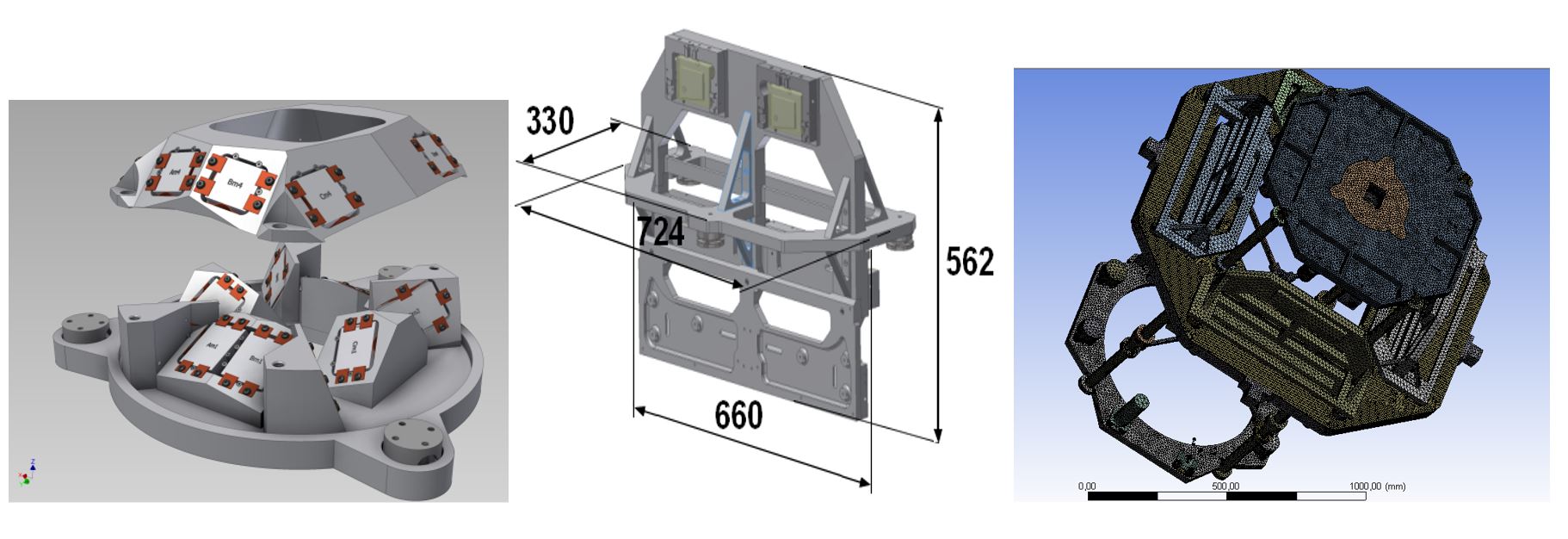
Integral-field spectrograph (0.5 to 2.45 µm) with a resolution ranging from 4000 to 20000 for the Extremely Large Telescope (ELT) equipped with a 39-meter-diameter primary mirror, and built by the European Southern Observatory (ESO) in Chile at the Armazones site. CRAL is responsible for the relay system and the image splitter of the HARMONI integral-field spectrograph. In fact, the mechanical engineering team designs the mechanical assembly of the relays and the image splitter for the integral-field spectrograph. They also analyze the assembly using finite element calculations to ensure the instrument functions correctly.
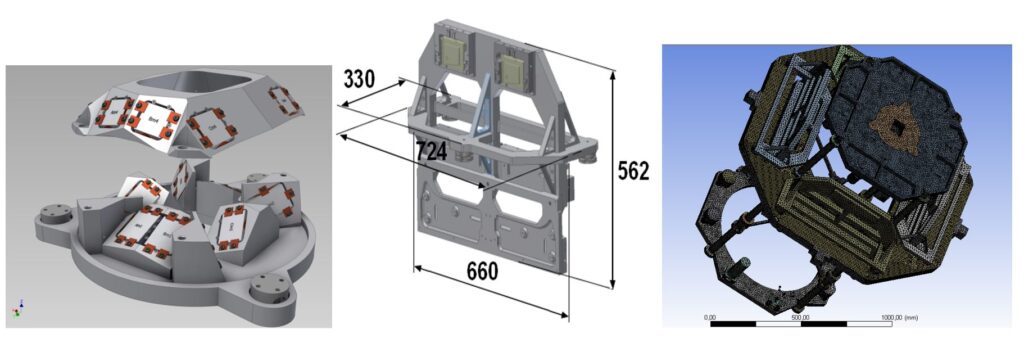
A low-resolution (R=5000) and high-resolution (R=20000) wide-field fiber spectrograph dedicated to large galactic and extragalactic surveys in the visible spectrum (390–930 nm). 4MOST is scheduled to be installed on the VISTA telescope at the European Southern Observatory (ESO) in Chile, at the Paranal site, by 2024. CRAL is responsible for the low-resolution spectrographs. In fact, the mechanical engineering staff designed the mechanical layout of the entire low-resolution spectrograph. They then broke it down into various subassemblies with technical specifications. They drafted the technical sections of the requests for proposals to select and evaluate contractors for outsourced work. Finally, they organized the monitoring of the manufacturing process and validated and qualified the mechanical subassembly. From 2019 to 2021, they are participating in the integration and validation of the subassemblies with one another in the integration hall at the Lyon1 site in Saint-Genis-Laval. In 2022, he is actively involved in the integration of the two low-resolution spectrographs at the Leibniz Institute for Astrophysics in Potsdam, to be qualified alongside the other 4MOST subsystems. In 2025, they will be integrated onto the VISTA telescope for sky validation.
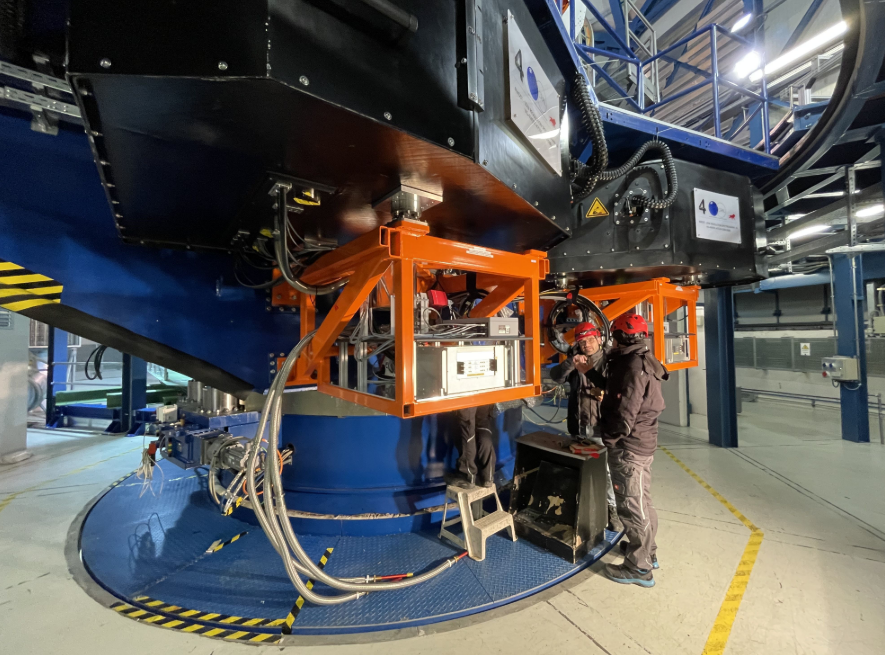
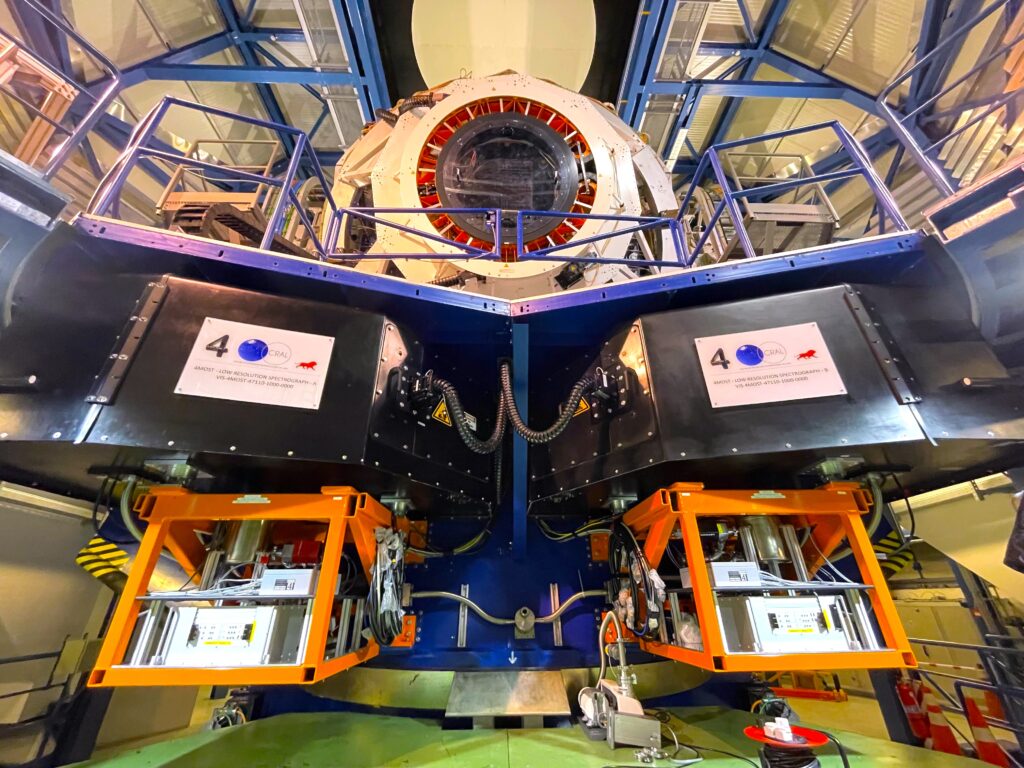
- R&D Activities: Testing of opto-mechanical assemblies in a cryogenic environment for future infrared-sensitive instruments
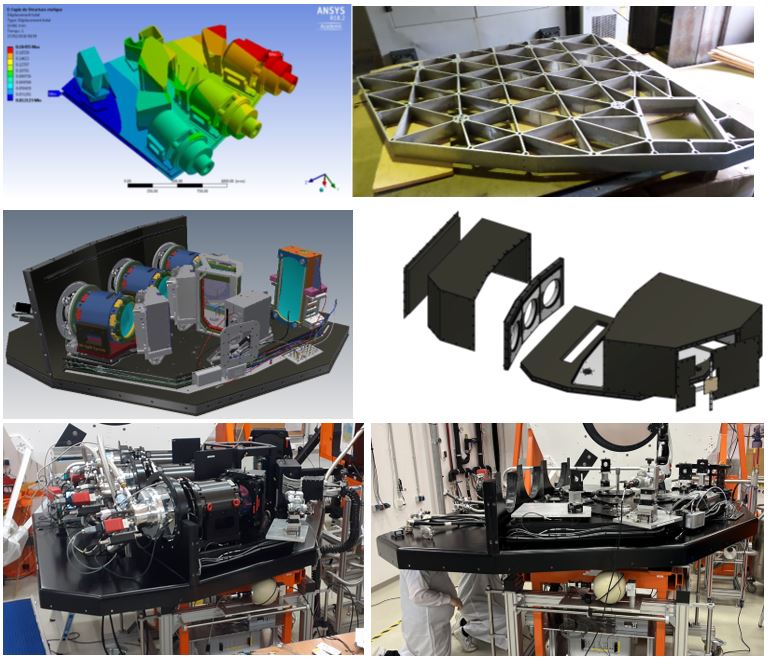
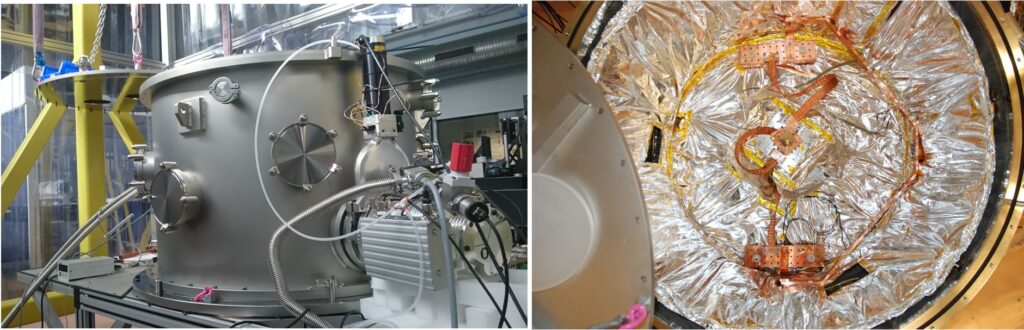
To design the best possible infrared instruments, high levels of precision in optical positioning must be achieved despite a very cold environment (instruments cooled to 130 K). CRAL’s mechanical engineering experts are therefore conducting extensive research to improve opto-mechanical designs. To this end, they have designed and assembled a 1 m³ test cryostat in which they can test various prototypes of mirror mounts and thus validate different clamping and positioning concepts, different techniques for distributing the cold, and also test different materials (stainless steel, aluminum, ceramics). To carry out this work, he has also developed, in collaboration with his colleagues who are optical experts at CRAL, several highly precise optical metrology tools to measure the positioning of the optics inside the cryostat. This innovative metrology is complex and constitutes an important area of research in its own right.
The mechanical engineering experts at CRAL have previously made significant contributions to numerous recognized projects, such as:
- TIGRE, the world’s first integral-field spectrograph
- OASIS (Optically Adaptive System for Imaging Spectroscopy), installed in 1997 on the Canada-France-Hawaii Telescope at the Mauna Kea Observatories in Hawaii, United States.
- SAURON (Spectrographic Areal Unit for Research on Optical Nebulae), installed in 1999 on the William Herschel Telescope located in the Canary Islands, Spain
- SNIFS (SuperNova Integral Field Spectrograph), installed in 2004 on the UH2.2 telescope at the Mauna Kea Observatories in Hawaii, United States
- MUSE, installed in 2014 on a unit of ESO’s Very Large Telescope located at Paranal, Chile.
At CRAL, mechanical engineering experts regularly attend advanced training courses in their fields of expertise at leading training centers in France and abroad. Committed to knowledge transfer, it welcomes numerous interns each year from mechanical engineering programs (CAP/BEP, BAC PRO, BTS, DUT, and engineering schools) across all fields (design office, calculation, manufacturing, and maintenance) for varying durations. It also welcomes 9th-grade students preparing for their career choices. Additionally, it participates in the maintenance and renovation of public-access astronomical instruments at the University of Lyon 1’s Saint-Genis-Laval campus, such as the 1-meter telescope and the equatorial refractor.