ALMA observes a cosmic battle 11 billion light-years away
A spectacle that comes to us from the early days of the universe
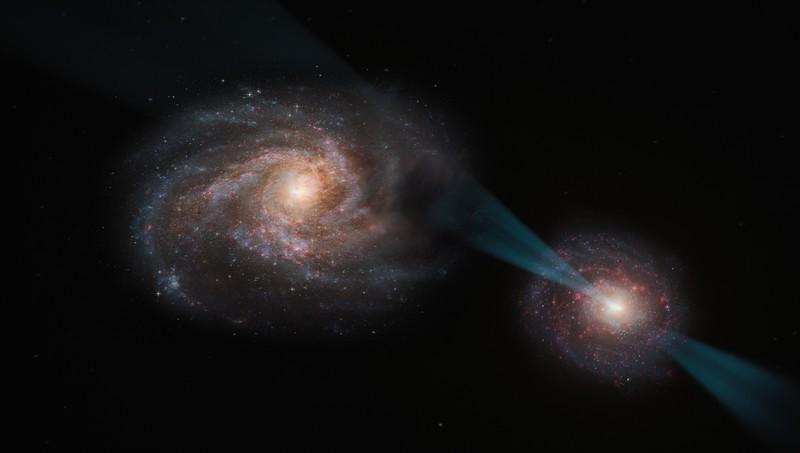
A team of astronomers—including Jens-Kristian Krogager of CRAL—has observed, for the first time, a violent cosmic collision in which one galaxy pierces another with intense radiation. Their findings, published in the journal Nature, show that this radiation impairs the injured galaxy’s ability to form new stars.
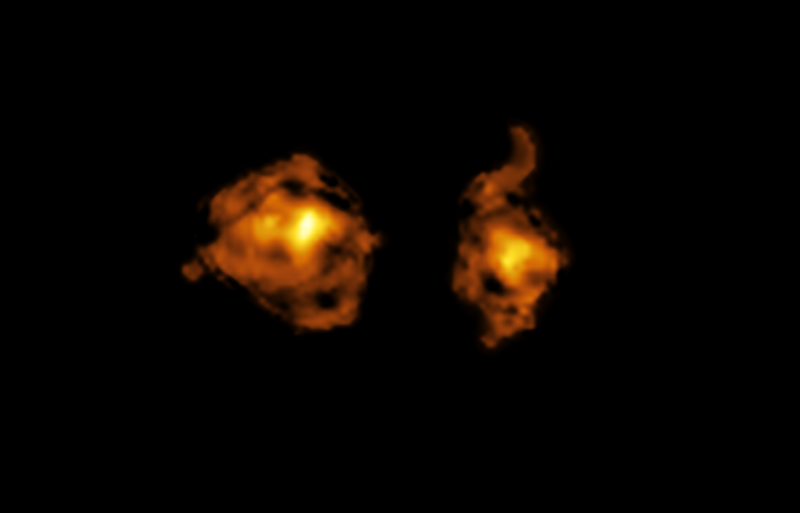
In the distant depths of the Universe, two galaxies are engaged in a spectacular war. Time and again, they rush toward each other at a speed of 500 km/s on a violent collision course, only grazing their target before pulling back for another round. “We therefore call this system the cosmic joust,” explains Pasquier Noterdaeme, co-author of the study and researcher at the Paris Astrophysics Institute and the Franco-Chilean Laboratory for Astronomy, referring to the medieval sport. But these galactic knights are anything but chivalrous, and one of them has a particularly unfair advantage: it uses a quasar to pierce its opponent with a lance of radiation.
Quasars are the brilliant cores of certain distant galaxies that are powered by supermassive black holes, releasing enormous amounts of radiation. Quasars and galaxy mergers were once much more common, appearing more frequently during the first few billion years of the Universe, so to observe them, astronomers look back into the distant past using powerful telescopes. The light from this “cosmic joust” took more than 11 billion years to reach us, so we see it as it was when the Universe was only 18% of its current age.
.
Gas reshaped by extreme radiation
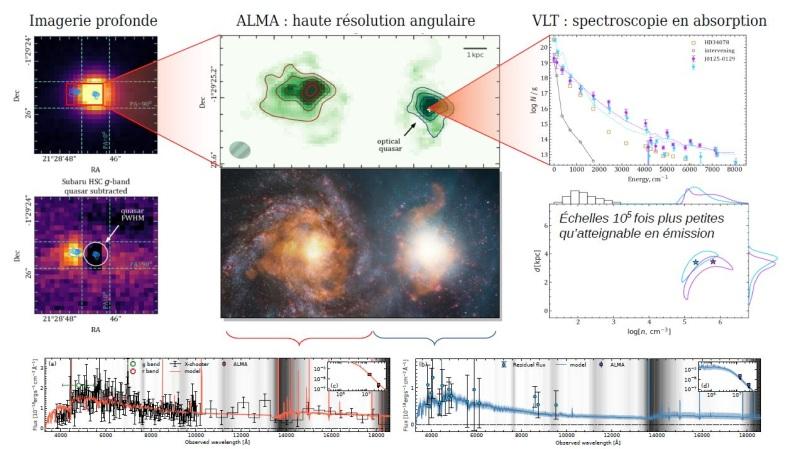
Since the quasar lies behind the companion galaxy, the researchers were able to analyze the absorption produced by the latter in the quasar’s spectrum. They detected extremely dense molecular gas clouds (n ≈ 10⁵ – 10⁶ atoms/cm³) and very compact (<0.02 pc), much smaller than those usually observed in absorption in galaxies distant from the background quasar. The high excitation of the gas indicates that it is exposed to ultraviolet radiation a thousand times more intense than that of our Milky Way. As a result: the quasar’s radiation dissociates most of the diffuse molecular gas, leaving only pockets of matter dense enough to withstand it… but too small to give birth to stars, thus depriving the wounded galaxy of its stellar nurseries in a transformation as spectacular as it is radical. “This is the first time we have directly observed the effect of quasar radiation on the internal structure of the gas in an otherwise normal galaxy,” explains Sergei Balashev, co-author of the study and a researcher at the Ioffe Institute in Saint Petersburg.
But this galactic victim is not the only one to be transformed. Sergei Balashev explains: “It is believed that these mergers deliver enormous amounts of gas to the supermassive black holes at the centers of galaxies.” In this cosmic clash, new fuel reserves are made available to the black hole that powers the quasar. As the black hole feeds, the quasar can continue its devastating assault.
Furthermore, this discovery highlights a localized feedback process never before observed. The quasar’s intense radiation restructures the interstellar matter in its immediate vicinity, preventing star formation in the irradiated zones. This phenomenon is detected on scales 100,000 times smaller than those accessible through emission observations. The researchers have thus helped characterize a unique system, revealing the multiple effects of quasars on the evolution of galaxies during their formation.
.
An observation made possible by state-of-the-art equipment
This study was conducted using ALMA and the X-shooter instrument on ESO’s VLT, both located in the Atacama Desert in Chile. ALMA’s high resolution allowed astronomers to clearly distinguish the two merging galaxies, which are so close to each other that they appeared to form a single object in previous observations. Using X-shooter, the researchers analyzed the light from the quasar as it passed through the normal galaxy. This allowed the team to study how this galaxy was affected by the quasar’s radiation during this cosmic battle.
Observations with larger and more powerful telescopes could reveal more about this type of collision. As Pasquier Noterdaeme says, a telescope like ESO’s Extremely Large Telescope “will certainly allow us to delve deeper into the study of this system, and others, in order to better understand the evolution of quasars and their effect on host galaxies and neighboring galaxies.”
For more information:
- Find this press release and all related images and videos on the ESO website by clicking here.
- You can also find this news item on the CNRS Terre & Univers website by clicking here.
- Article reference: BALASHEV, Sergei; NOTERDAEME, Pasquier; GUPTA, Neeraj; KROGAGER, Jens-Kristian; COMBES, Françoise; LOPEZ, Sebastian; PETITJEAN, Patrick; OMONT, Alain; SRIANAND, Raghunathan; CUELLAR, Rodrigo. Quasar radiation transforms the gas in a merging companion galaxy. Nature, 641, 1137-1141 (2025). https://doi.org/10.1038/s41586-025-08966-4

- ESO has produced several short videos to present these new results: