
James Webb Discovers Its First Exoplanet
Rings in debris disks
Since it became operational in 2022, the James Webb Space Telescope has characterized several previously known exoplanets. Thanks to an international team led by the Paris Observatory, which includes Olivier Flasseur and Maud Langlois from CRAL, it has just captured a direct image of a previously unknown exoplanet. This discovery, published on June 25, 2025, in the journal Nature, is a first for the telescope. It was made possible by a French-made coronagraph installed on the JWST’s MIRI instrument.
The search for exoplanets is a major goal of modern astronomy. These exoplanets help us understand how planetary systems form. For the first time since its launch in 2021, the James Webb Space Telescope (JWST) has led to the discovery of a new exoplanet. It is located in a disk of debris and dust surrounding a young star. This planet is the lightest ever observed through direct imaging. It marks an important step toward imaging increasingly less massive planets, more similar to Earth.
Exoplanets are prime targets in astronomical observation because they help us better understand how planetary systems form, including our own. While several thousand have been detected indirectly (see additional information below), obtaining images of exoplanets is a real challenge. They are, in fact, dim and, as seen from Earth, are located very close to their star. Their signal is drowned out by that of the star, without standing out enough to be visible. To overcome this problem, the CNRS, in collaboration with the CEA, has developed a device for the JWST’s MIRI instrument: a coronagraph. It replicates the effect observed during an eclipse; by blocking out the star, it becomes easier to observe the objects surrounding it without them being obscured by the star’s light. It is this technique that enabled a research team led by a CNRS researcher to discover a new exoplanet, the first to be discovered by the JWST. It is located in a disk of rocky debris and dust.
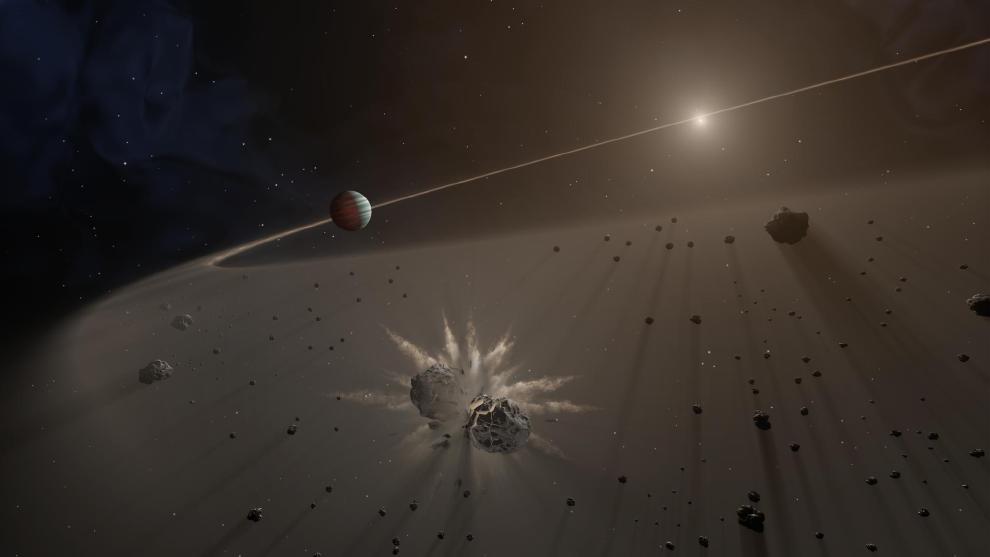
Credit: NASA / JPL-Caltech
Scientists prioritized the most promising observation targets: systems a few million years old, viewed from Earth with the star’s pole aligned, a configuration that allows the disks to be seen “from above.” Planets that have just formed in these disks are still hot, making them brighter than their older counterparts. Low-mass planets are generally easier to detect in the mid-infrared spectrum, where the JWST has opened a unique observational window. Among all the disks viewed edge-on, two have particularly caught the researchers’ attention, as previous observations revealed concentric ring structures within them.
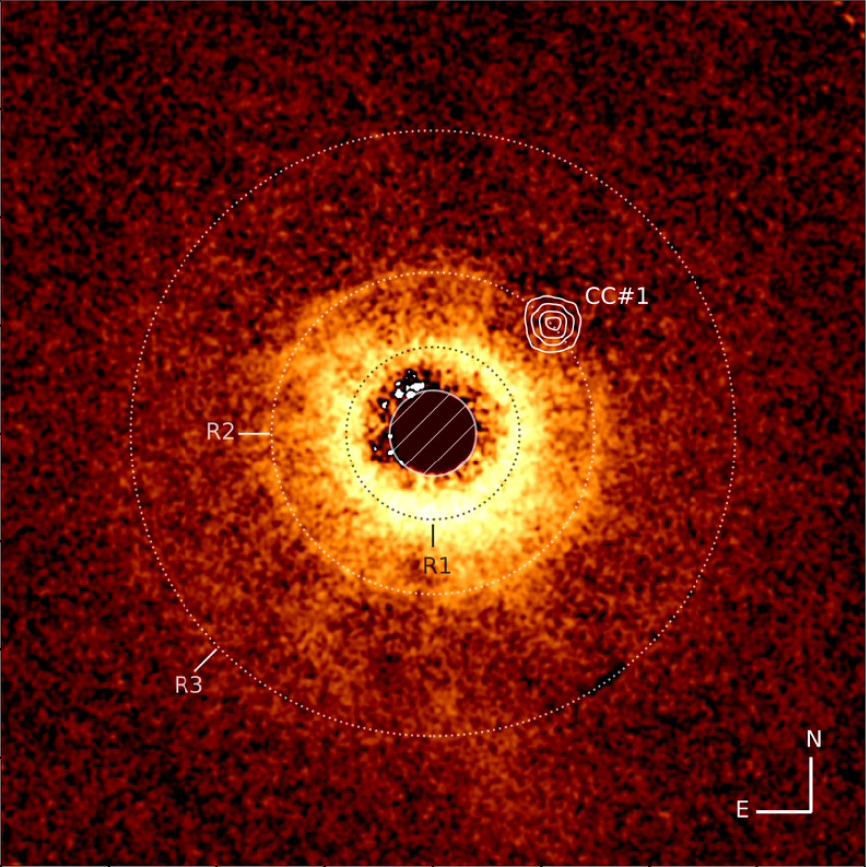
Scientists had previously suspected these structures to be the result of gravitational interactions between unidentified planets and planetesimals. Called TWA 7, one of the two systems features three distinct rings, including a particularly thin one, surrounded by two nearly empty regions devoid of material. The image obtained by the JWST revealed a source at the very heart of this thin ring. After ruling out the possibility of an observational bias, scientists concluded that it is most likely an exoplanet. Detailed simulations have indeed confirmed the formation of a thin ring and a “hole” at the exact position of the planet, in perfect agreement with the observations made by the JWST.
What are the prospects for future exoplanet discoveries?
Named TWA 7 b, this new exoplanet is ten times lighter than those imaged so far! Its mass is comparable to that of Saturn, or about 30% of that of Jupiter, the most massive planet in the Solar System. This result marks a new milestone in the search for and direct imaging of increasingly lighter exoplanets. The JWST has the potential to go even further in the future. Scientists hope to be able to image planets that may be as little as 10% of Jupiter’s mass. This discovery paves the way for imaging Earth-like exoplanets. They will be the focus of future generations of space- and ground-based telescopes, some of which will also use more advanced coronagraphs. The most promising candidate systems are already being identified for these future observations.
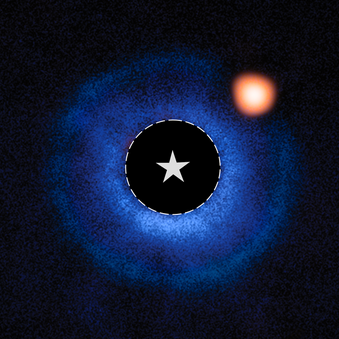
Above right: an image combining ground-based data from the SPHERE instrument on the European Southern Observatory’s Very Large Telescope (debris disk shown here in blue) and data from the JWST’s MIRI instrument (TWA 7 b, shown here in orange). The star has been hidden and is located at the center of the dotted circle.
For more information
- Download this press release from CNRS / Paris Observatory / Université Grenoble-Alpes with scientific contacts
- Article reference: LAGRANGE; A.-M.; WILKINSON, C.; MÂLIN, M.; BOCCALETTI, A.; PERROT, C.; MATRA, L.; COMBES, F.; BEUST, H.; ROUAN, D.; CHOMEZ, A.; MILLI, J.; CHARNAY, B.; MAZEVET, S.; FLASSEUR, O.; OLOFSSON, J.; BAYO, A.; KRAL, Q.; CARTER, A.; CROTTS, K. A.; DELORME, P.; CHAUVIN, G.; THEBAULT, P.; RUBINI, P.; KIEFER, F.; RADCLIFFE, A.; MAZOYER, J.; BODRITO, T.; STASEVIC, S.; LANGLOIS, M. Evidence for a sub-Jovian planet in the young TWA 7 disk. Nature, June 25, 2025, https://doi.org/10.1038/s41586-025-09150-4.