First light for 4MOST, the next-generation cosmograph
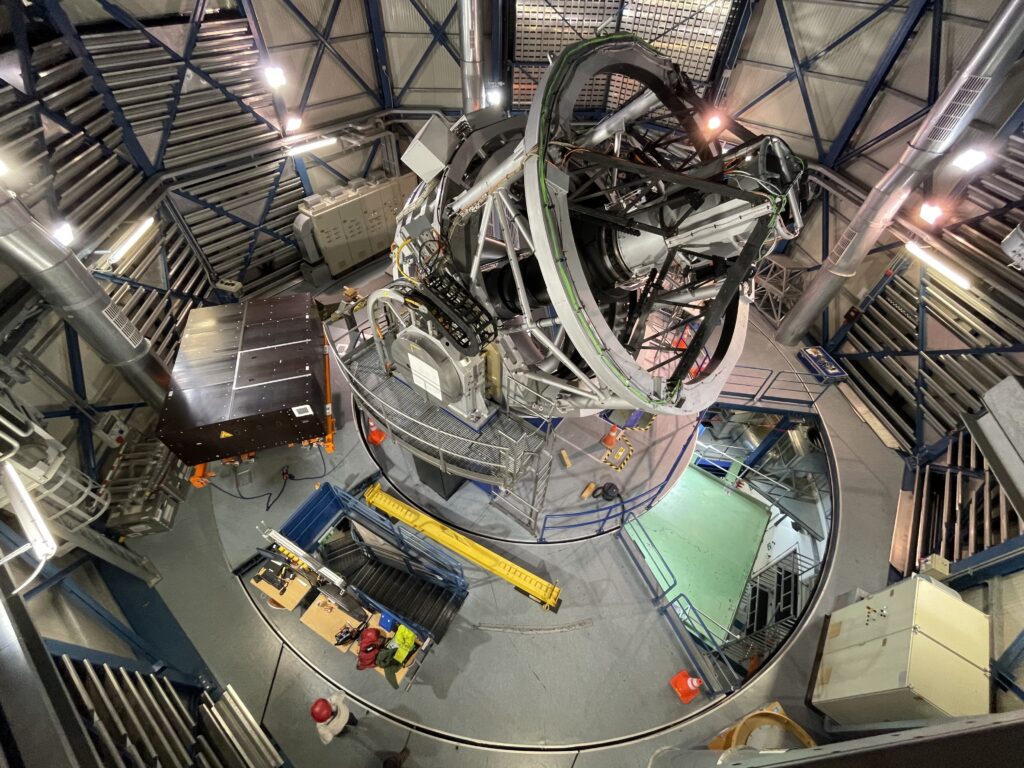
On October 18, 2025, the 4MOST instrument, installed in Chile on the European Southern Observatory’s (ESO) VISTA telescope, received its first light. This first beam of light from space, analyzed by the instrument’s spectrographs, marks the beginning of a major adventure in studying and mapping the sky: thanks to its cutting-edge technology, 4MOST can study the light from 2,400 celestial objects simultaneously—every 15 minutes.
An instrument to map the Universe at record speed
On October 18, 2025, the 4MOST (4-Metre Multi-Object Spectroscopic Telescope) instrument, installed on the European Southern Observatory’s (ESO) VISTA telescope in the Atacama Desert in Chile, saw first light. This crucial milestone in the life of astrophysical instruments marks the beginning of its scientific journey. This first light is not just a simple image of space: 4MOST records spectra, meaning it captures the light from celestial objects across all wavelengths—the colors—from ultraviolet to infrared. Thanks to independent optical fibers, it can simultaneously observe 2,436 celestial objects across 18,000 wavelengths.
Once the instrument is fully operational, 4MOST’s three spectrographs will allow astronomers to study in detail numerous fields of research: the composition of stars; the formation and evolution of planetary systems; the past history of our Milky Way; distant galaxies; black holes; the origin of chemical elements; dark matter and dark energy; and more. By analyzing the spectra of thousands of objects every 10 to 20 minutes, researchers will be able to catalog the temperatures, chemical compositions, motions, and distances of tens of millions of celestial objects in the southern sky.
Under development since 2010 and expected to be operational for at least fifteen years, 4MOST is the largest multi-object spectrograph in the southern hemisphere. Its combination of a wide field of view (five times larger than the Moon), the number of simultaneous sources it can observe, and the level of detail in its spectra make it a unique instrument in the world that promises numerous discoveries.
A significant French contribution
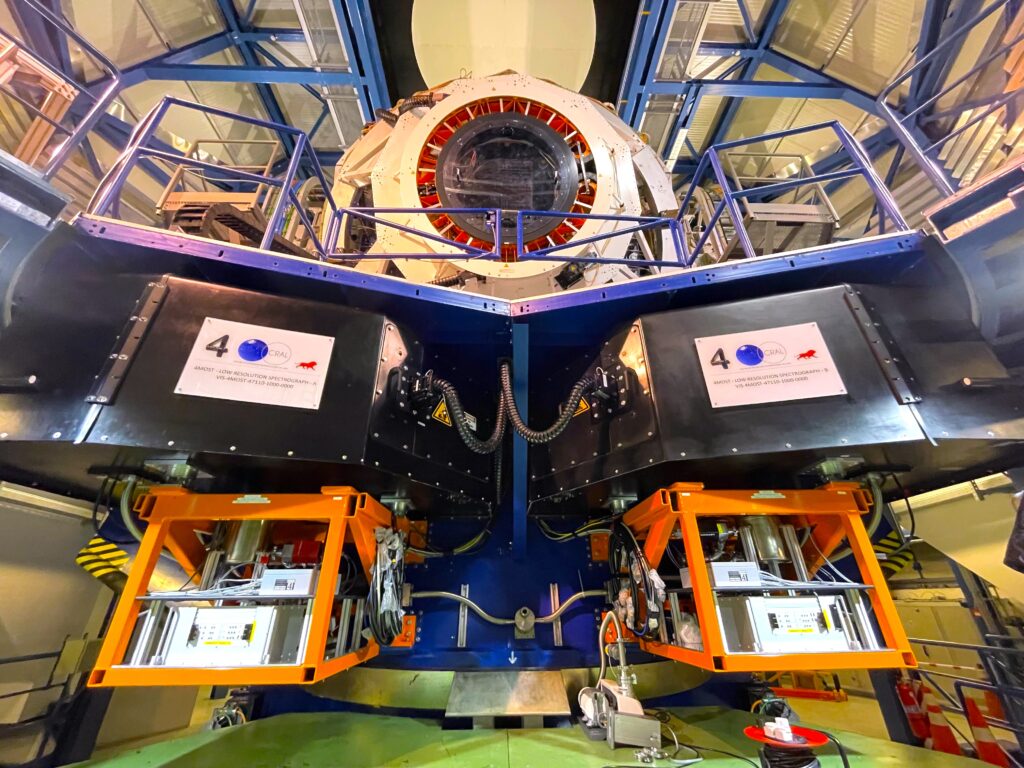
France and the CNRS have played a major role in the development of this European instrument: two of its three spectrographs were built by the Lyon Astrophysics Research Center (CRAL) at the Lyon Observatory.
These two identical “low-resolution” spectrographs (LRS) are essential to 4MOST’s sky survey mission, providing continuous coverage of wavelengths between 370 and 950 nm. The third, known as the “high-resolution” spectrograph, can produce more detailed spectra in three narrower spectral bands. These spectrographs, each connected to 812 optical fibers as thin as a strand of hair, will enable large-scale surveys of the sky, making VISTA—with its 4-meter mirror—the world’s largest telescope dedicated to this type of research.
The French team at CRAL consists of about fifteen engineers, technicians, and researchers who have been involved since 2014 in the design, assembly, and testing of the spectrographs, leading up to their installation on the telescope this summer. “4MOST has been an exceptional human and technical adventure,” says Florence Laurent, an optical engineer at CRAL. “Led by international teams with complementary talents spread across multiple sites, this project illustrates the power of a collective effort united by a common ambition: science.” ” The instrument is eagerly awaited by the entire astrophysics community, as Johan Richard, an astronomer at CRAL, explains: “It will increase our ability to map large regions of the sky tenfold. The sheer volume of physical measurements we’ll obtain on such distant objects is truly impressive!”
A promising first light
4MOST’s first light demonstrates the instrument’s full potential, capable of observing a wide field while individually analyzing thousands of diverse astronomical objects in detail.
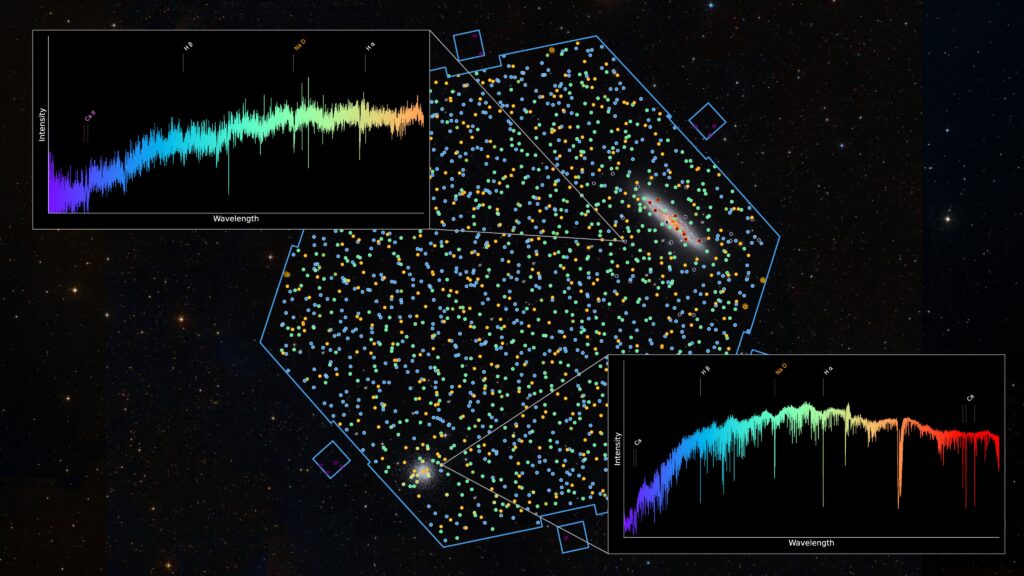
The most remarkable object in these initial observations is the Sculptor Galaxy (NGC 253), the largest in the southern sky after the two Magellanic Clouds. Its apparent diameter is equivalent to that of the Moon, but its fainter luminosity makes it much less visible. Discovered by Caroline Herschel in 1783, it is located 11.5 million light-years away from us and is producing many new stars.
Another object visible in the first 4MOST observations is the globular cluster NGC 288, a very dense group of about 100,000 stars located on the outskirts of our galaxy. It formed more than 13 billion years ago, at the very beginning of the Milky Way’s history, which means its stars are poor in chemical elements heavier than hydrogen or helium.
These two objects are not the only ones to have been studied during this first scientific observation: the spectra of more than 2,000 other sources were also analyzed. Among these are stars in our galaxy whose temperature, mass, diameter, velocity, age, and chemical composition are now known. Further away from us, 4MOST has (simultaneously) obtained the spectra of more than 100 galaxies, up to 10 billion light-years away. These measurements have provided scientists with information about their distance, motion, evolution, and central black holes.
More than 700 people from universities and research organizations around the world will work with 4MOST. Twenty-five scientific programs are already in place for the next five years—including two led by CRAL researchers—and involve several CNRS research units.
- Video: “The 4MOST Instrument for the VISTA Telescope”
- Video: Presentation of one of the two Low Resolution Spectrographs produced at the Lyon Observatory before its departure for integration in Potsdam. Credits: Knowledge Dissemination Service of the Lyon Observatory
- Video: “4MOST Spectrographs Installed — Our New Eye on the Cosmos!” Credits: Allar Saviauk / AIP