Seminar by Mathias Nowak – (LIRA, Paris)
Results and Outlook from the ExoGRAVITY Large Program
Abstract
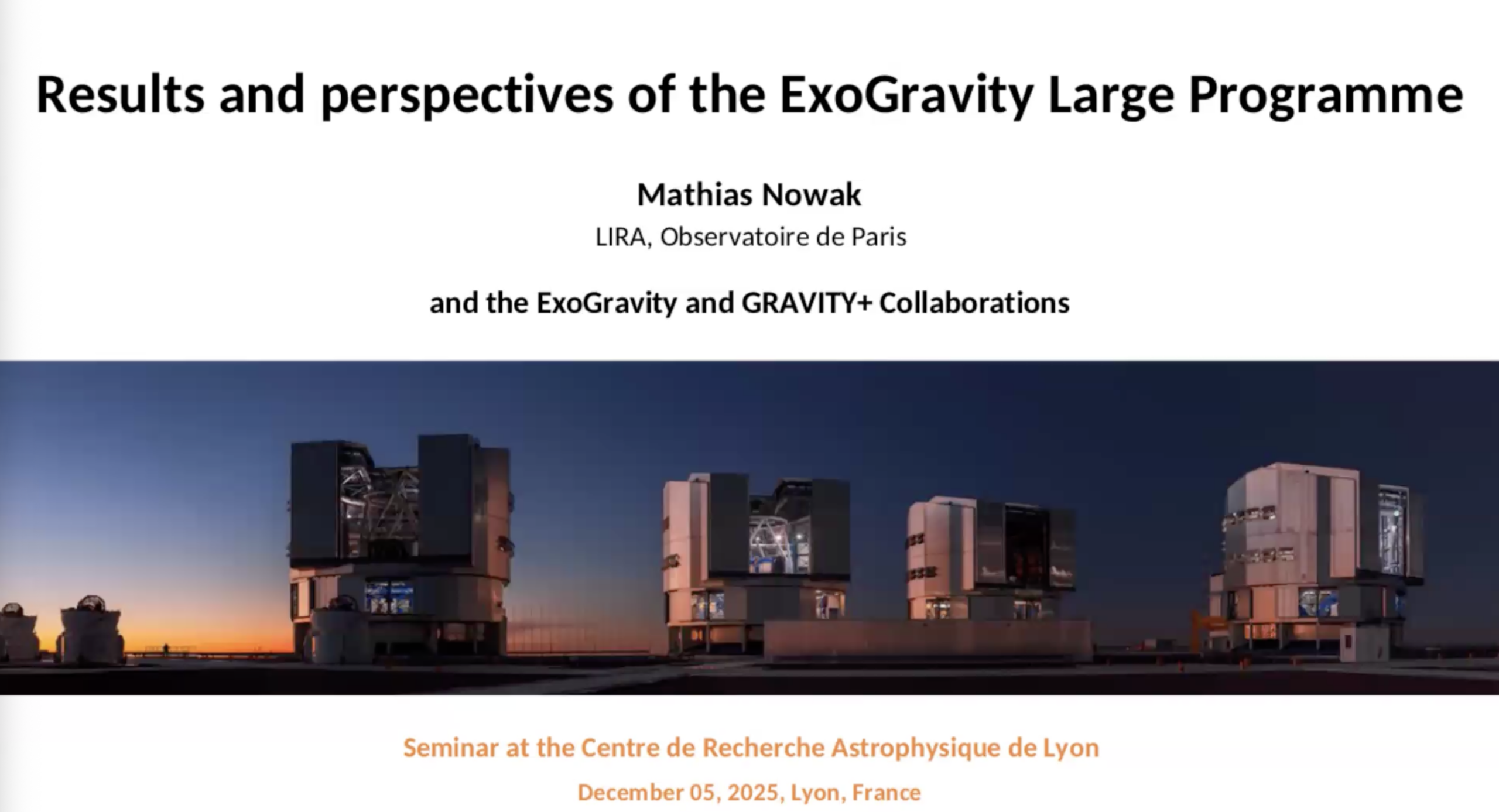
The direct detection of a giant exoplanet using long-baseline interferometry in 2019 marked the debut of the GRAVITY instrument in exoplanet research. This breakthrough was followed by the detailed spectroscopic characterization of beta Pictoris b’s atmosphere in 2020, demonstrating the potential of long-baseline interferometry for studying young giant planets. These successes led to the establishment of the ExoGRAVITY Large Program on the Very Large Telescope Interferometer (VLTI), dedicated to the characterization of young giant planets. Fast forward five years, and this innovative method has yielded a wealth of discoveries, including the direct confirmation of beta Pictoris c, the detection of brown dwarf companions inferred from Gaia data, and the resolution of the “underluminous” brown dwarfs puzzle. The implementation of GRA4MAT has expanded observational capabilities to include longer wavelengths (L to N bands), while the GRAVITY+ upgrade promises enhanced contrast at small separations in the K-band. Initiatives are now underway to explore shorter wavelengths (J and Y bands) at the VLTI, offering strong potential for exoplanet studies. The detection of giant planets in reflected light, rather than thermal emission, is rapidly becoming the next frontier in high-contrast interferometry, inspiring more ambitious ideas, such as adding a new Unit Telescope (UT) to the VLTI array. In this talk, I will review the key results of the ExoGRAVITY Large Programme and provide insights into upcoming developments in high-contrast interferometry for exoplanet characterization.