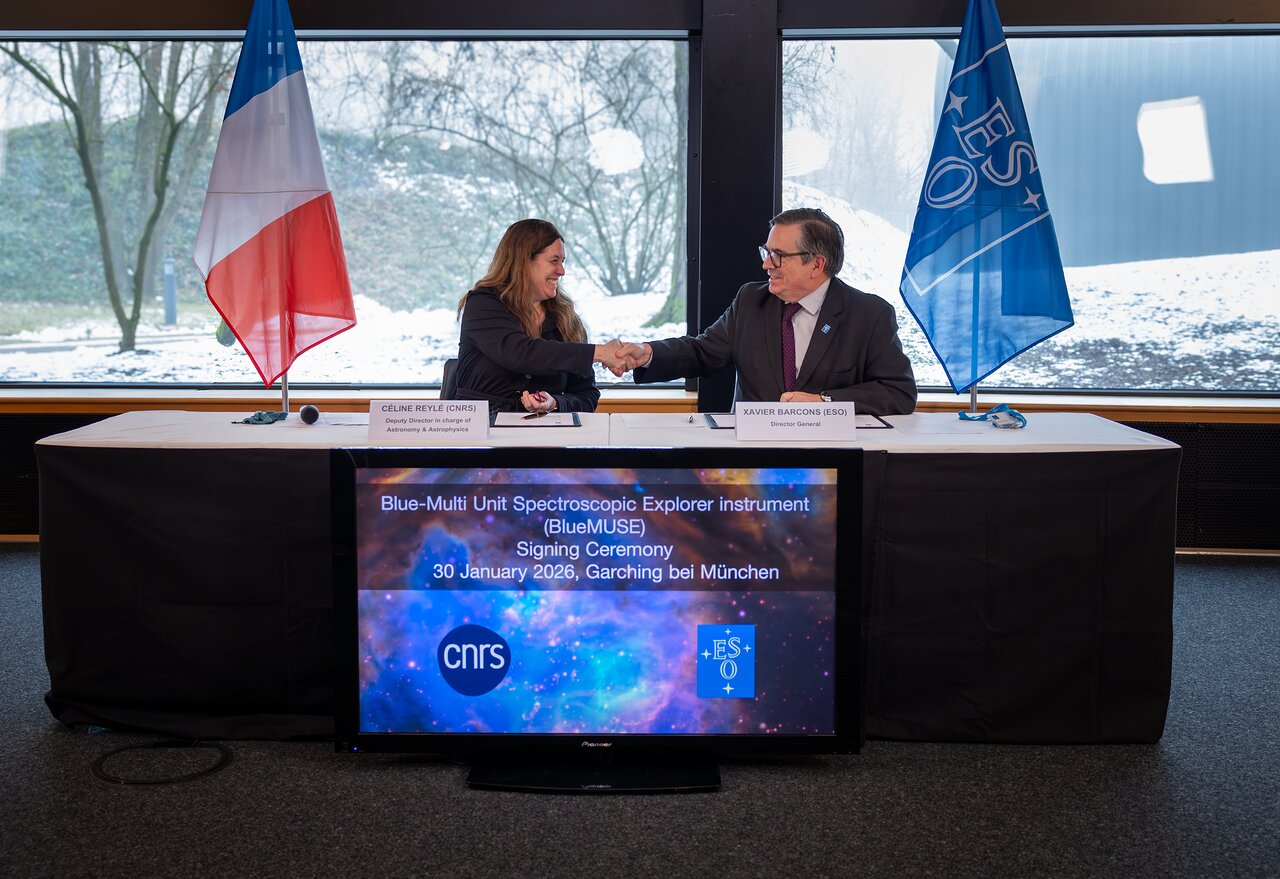
On January 30, 2026, ESO signed the agreement for the construction of the Blue Multi Unit Spectroscopic Explorer (BlueMUSE), a new instrument for ESO’s Very Large Telescope (VLT). This signing marks an important first step in the development of BlueMUSE, which will offer astronomers new and unique scientific opportunities. Its advanced technology will enable detailed observations within our galaxy, facilitating the study of targets as varied as massive stars, nebulae, and comets. It will also revolutionize the study of the distant Universe by enabling the detection of diffuse matter in the space between galaxies and helping us understand how matter moves there.
Earlier today, Xavier Barcons, Director General of ESO, and Céline Reylé, Deputy Director of the Astronomy and Astrophysics Department at the National Center for Scientific Research (CNRS), signed the BlueMUSE agreement at ESO headquarters in Garching, Germany. The Lyon Center for Astrophysical Research (CRAL, CNRS/ENS de Lyon/Université Claude Bernard Lyon 1) of the CNRS is the institution leading the instrumental consortium, composed of several European and Australian institutes. Also present were BlueMUSE’s scientific lead, Johan Richard, and the project manager, Rémi Giroud, both from CRAL, as well as the French scientific and academic attaché for Southern Germany, Emmanuel Delille, and other dignitaries from ESO and the BlueMUSE consortium to mark the next stage in the instrument’s construction.
Based on the proven technology of the MUSE instrument installed at the VLT, BlueMUSE is a full-field spectrograph. It is designed not only to capture a 2D image of a target (or multiple targets), but also to break down the light into its different colors or wavelengths at each pixel, thereby producing a complete 3D dataset containing detailed information about the observed object.
Since MUSE has become one of ESO’s most productive and in-demand instruments, the astronomical community has long hoped for a similar instrument—and that is now becoming a reality.
Although similar to MUSE in many ways, BlueMUSE will observe at shorter and therefore bluer wavelengths, with higher spectral resolution (the ability to distinguish different wavelengths more precisely). This means it will perfectly complement large ground-based and space-based facilities, such as ESO’s future Extremely Large Telescope and the James Webb Space Telescope, which are optimized for infrared observation.
Scheduled to see first light in 2034, BlueMUSE will open up new scientific possibilities, beyond those offered by MUSE. It will enable the study of a larger number of massive stars in the Milky Way and its galactic neighborhood, thereby helping to answer fundamental questions about stellar evolution. Furthermore, it will be capable of observing faint galaxies, as well as starburst galaxies, to study their extreme star-forming environments. BlueMUSE will also be ideally suited for studying the distant Universe, particularly for detecting the very diffuse and elusive matter that permeates the space between galaxies, as well as for studying the emergence of the first galaxy clusters.
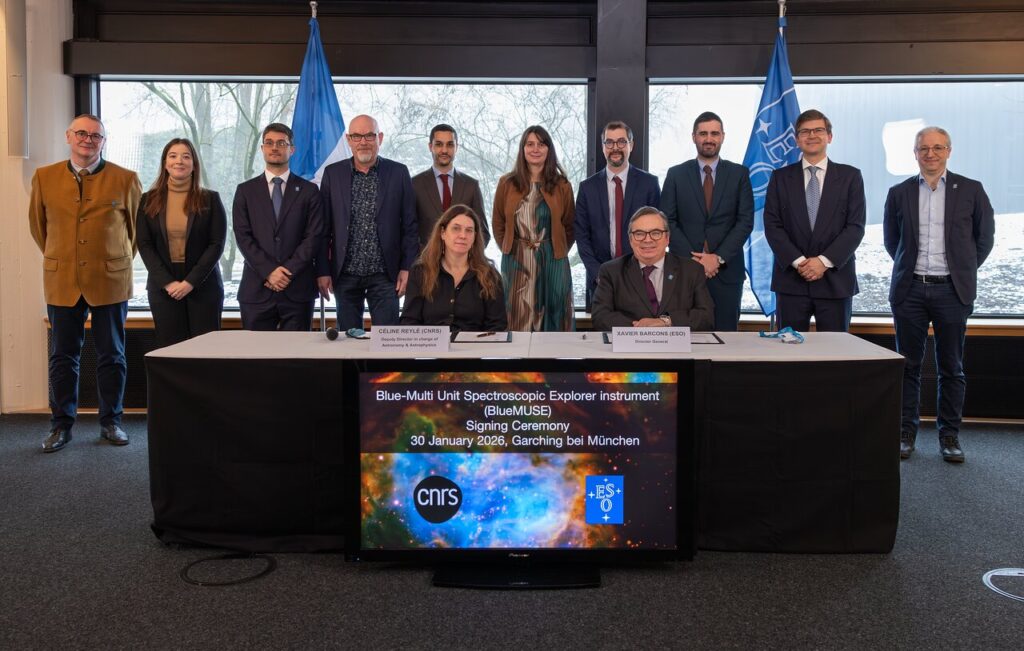
The BlueMUSE project team poses for a photo during the instrument signing ceremony. Among the CRAL members: Johan Richard (PI), Rémi Giroud (Project Manager), Florence Laurent (Systems Engineer), Alexandre Jeanneau (Principal Optics Engineer)
France’s role in BlueMUSE:
The CNRS is involved in the project through two laboratories: CRAL is the laboratory where most of the project office is located, and which will be responsible for the instrument’s image splitters as well as final integration. The AIM, via the IRFU, will be in charge of a key subsystem involving the detectors and cryogenic systems.
BlueMUSE builds on the CNRS’s recognized expertise in spectroscopy and spectroimaging, particularly at CRAL since the 1990s. CRAL previously led the MUSE project on the VLT and has been a major partner in the 4MOST and now HARMONI projects on the ELT.
More information
The BlueMUSE project will be led by an international consortium comprising nine research institutes in various countries and ESO, namely:
- United Kingdom: Centre for Advanced Instrumentation and Centre for Extragalactic Astronomy, Physics Department, Durham University
- Australia: Australian Astronomical Optics; Macquarie University
- France: Lyon Astrophysics Research Center (CRAL – CNRS/ENS de Lyon/Claude Bernard Lyon 1 University; lead); Astrophysics, Instrumentation & Modeling (AIM – CEA/CNRS/Université Paris Cité); Institute for Research on the Fundamental Laws of the Universe (CEA/Saclay)
- Germany: Leibniz Institute for Astrophysics Potsdam (AIP) in association with the Universities of Potsdam and Göttingen
- Portugal: Institute of Astrophysics and Space Sciences
- Sweden: Department of Astronomy, Stockholm University
- Switzerland: Astronomical Observatory of the University of Geneva; Laboratory of Astrophysics, Swiss Federal Institute of Technology in Lausanne (EPFL)