GALPAC
Research Areas
Galaxy Formation and Evolution
Studies of reionization and distant-universe galaxies
- through deep observations using most available instruments (notably VLT/MUSE, HST, ALMA) and by exploiting gravitational lensing effects (in particular, the Frontier Fields),
- using specialized semi-analytical models for distant galaxy populations (GALICS),
- via radiative hydrodynamic cosmological simulations (RAMSES) of the first galaxies. Radiation transfer of the ionizing continuum and the Lyman-alpha resonant line (MCLya).
Studies of the resolved properties of galaxies, whether distant or local,
- by observing distant ones via gravitational lensing,
- by analyzing and modeling the physical properties and stellar populations of local galaxies, notably using HyperLEDA.
Observational cosmology
- Large extragalactic surveys (Euclid, 4MOST)
- Supernova surveys (SNFactory) and standardization of Type Ia supernovae
- Galaxy clusters
Support and scientific exploitation of CRAL instrumental projects
- ESO-VLT/MUSE
- ESA-JWST/NIRSpec
- ESO-VISTA/4MOST
- ESO-ELT/HARMONI
- UH2.2-IfA/SNIFS
Researchers
- Roland BACON (Emeritus Research Director)
- Jérémy BLAIZOT
- Nicolas BOUCHÉ
- Adélaïde CLAEYSSENS BEAUPÈRE
- Bruno GUIDERDONI
- Jens-Kristian KROGAGER
- Matthew LEHNERT
- Emmanuel PÉCONTAL
- Philippe PRUGNIEL
- Johan RICHARD
- Joakim ROSDAHL (team leader)
- Isabelle VAUGLIN (website)
Associate Researchers
- Thibault GAREL (University of Geneva, CH)
- Boud ROUKEMA (University of Torun, PL)
- Anne VERHAMME (University of Geneva, CH)
Postdoctoral researchers
- Arghyadeep BASU
- Bianca Iulia CIOCAN
- Floriane LECLERCQ
Doctoral students
- Snigdha BHATTACHARJEE
- Masten BOURAHMA
- Felipe CORRO
- Corentin CUDENNEC
- Alexandre JEANNEAU
- Nai-Chieh Daniel LIN (with AstroENS)
- Julia SHOUSE
Visiting Researchers
- Julien DEVRIENDT (on secondment to Oxford, UK)
- Éric EMSELLEM (on secondment to ESO, Germany)
Former Postdoctoral Researchers
- Adrianne SLYZ
- Chris RIMES
- Andrea CATTANEO
- Stéphanie COURTY
- Anne VERHAMME
- Léo MICHEL-DANSAC
- Alyssa B. Drake
- Stephen HAMER
- Peter Mitchell
- Mohammad Akhlaghi
- Benjamin Clement
- Anna Feltre
- Hanae Inami
- Thibault GAREL
- Floriane LECLERCQ
- David CARTON
- David Lagatutta
- Jenny SORCE
- Johannes ZABL
- Mamta Pommier
- Édouard TOLLET
- Dieu NGUYEN DUC
- Yucheng GUO
- Guglielmo COSTA
- Louis Quilley
Former PhD students
- Thierry Sousbie (2006)
- Jaime Forero-Romero (2007)
- Nicolas Champavert (2007)
- Igor Chilingarian (2007)
- Mina Koleva (2009)
- Dylan Tweed (2009)
- Natasa Gavrilovic (2010)
- Xavier Roy (2011)
- Thibault Garel (2011)
- Maxime Bois (2011)
- Yue Wu (2011)
- Pierre-Yves Lablanche (2012)
- Joakim Rosdahl (2012)
- Alexandre Alles (2014)
- Fosca Al Roumi (2015)
- Kaushal Sharma (2016)
- Maxime Trebitsch (2016)
- Vera Patricio (2017)
- Guillaume Mahler (2017)
- Jean-Baptiste Courbot (2017)
- Raphael Bacher (2017)
- Floriane Leclercq (2017)
- Glenn Robbins (2018)
- Johany Martinez (2019)
- Mathieu Chuniaud (2021)
- Adelaïde Claeyssens (2021)
- Valentin Mauerhofer (2021)
- Marion FARCY (2022)
- Maxime Rey (2022)
- Maxime CHERREY (2024)
- Ivanna LANGAN (2024)
- Romain LENOBLE (with AstroENS, 2024)
- Quentin BASTO (2025)
Current projects
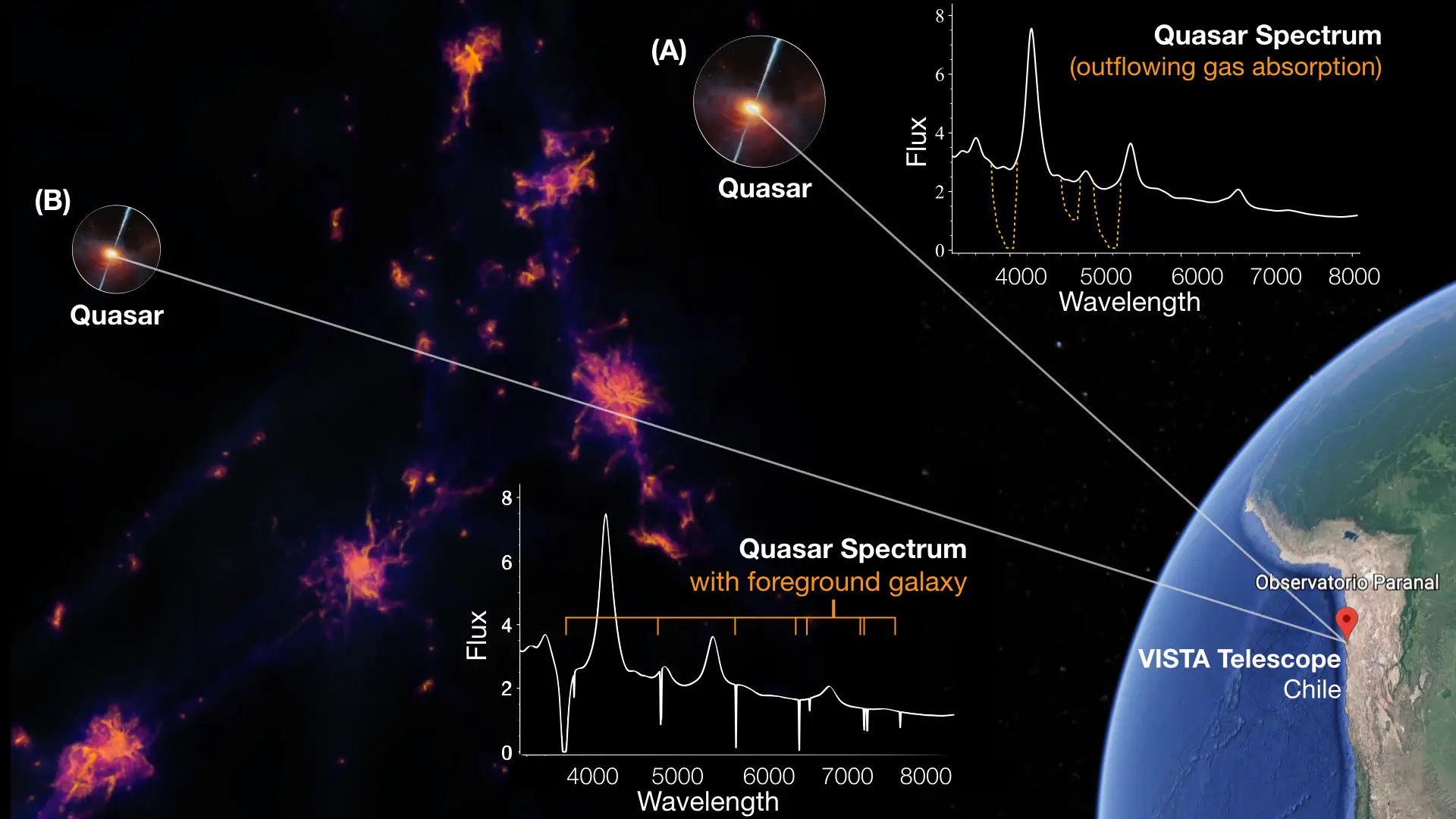
The 4MOST–Gaia Purely Astrometric Quasar Survey (4G–PAQS) will conduct the first large-scale, color-independent quasar survey selected solely on the basis of astrometry from Gaia. Our main objective is to quantify the selection effects of current color-selected samples. These color-selected samples bias our view of the neutral gas and its chemical enrichment due to dust obscuration and reddening of optical colors. Moreover, the broad absorption-line outflows observed in quasars are underrepresented by optical color selection. 4G–PAQS will provide the first sample selected solely using Gaia astrometry in order to overcome the challenges of color selection. The survey will observe nearly 250,000 quasar candidates selected around the South Galactic Pole.
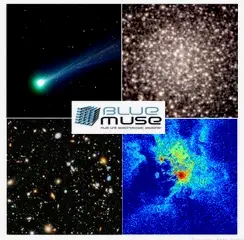
BlueMUSE is a panoramic integral field spectrograph, optimized for the blue, with medium spectral resolution and limited by atmospheric seeing conditions. It will be installed on one of the telescopes of the VLT (Very Large Telescope) located at Cerro Paranal (ESO), in Chile.
The project represents an evolution of the technology used for the highly successful VLT/MUSE instrument, whose architecture and technological innovations it adopts, while developing new scientific objectives made possible by its main characteristics:
-
a wavelength range covering 350 to 580 nm,
-
a medium spectral resolution of R=4000,
-
a field of view greater than 1 arcmin².
BlueMUSE will provide unique new scientific opportunities across many areas of astrophysics, beyond what is already possible with MUSE.
Among its main scientific goals:
-
the study of large samples of massive stars in our galaxy and in the Local Group,
-
the analysis of ionized nebulae, star-forming galaxies, and low surface brightness galaxies,
-
and, at high redshift, the direct detection of the intergalactic medium (IGM) in emission for the first time, as well as the study of the evolution of the circumgalactic medium (CGM) at the epoch of peak cosmic star formation.
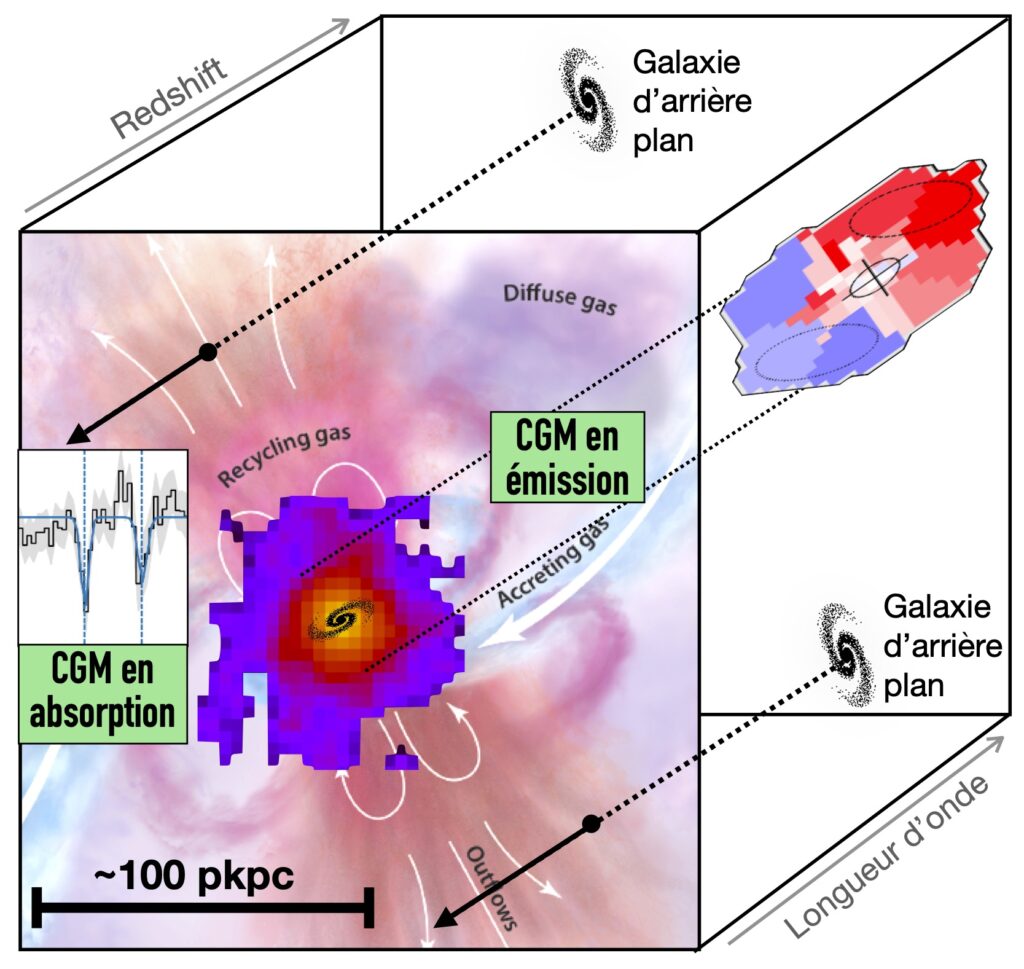
The C3UBES project (2024–2026) is funded by a European Marie Skłodowska-Curie grant secured and led by Floriane Leclercq (CRAL). This project aims to better understand how galaxies form and evolve by studying their circumgalactic medium (CGM), a vast envelope of gas that surrounds them and regulates their exchange of matter with the environment. Using deep data from the MUSE spectrograph, this project will, for the first time, map the diffuse gas around a large sample of distant galaxies by combining absorption and emission line techniques. The main objective is to characterize the gas content of the CGM, describe its morphology, and measure its kinematics—that is, the movements and exchanges of gas around the galaxies. By linking these properties to those of the galaxies themselves—such as their mass, star formation rate, or environment—the project will help us understand how the CGM fuels or inhibits galaxy growth.
The DARK project (2023–2027) is an ANR-funded project led by Nicolas Bouché (CRAL). It is dedicated to the analysis of dark matter within distant galaxies. The project aims to place strong constraints on dark matter profiles by using innovative techniques for 3D modeling of spiral galaxies based on MUSE data; and (ii) radiative-hydrodynamic simulations of disk galaxies.
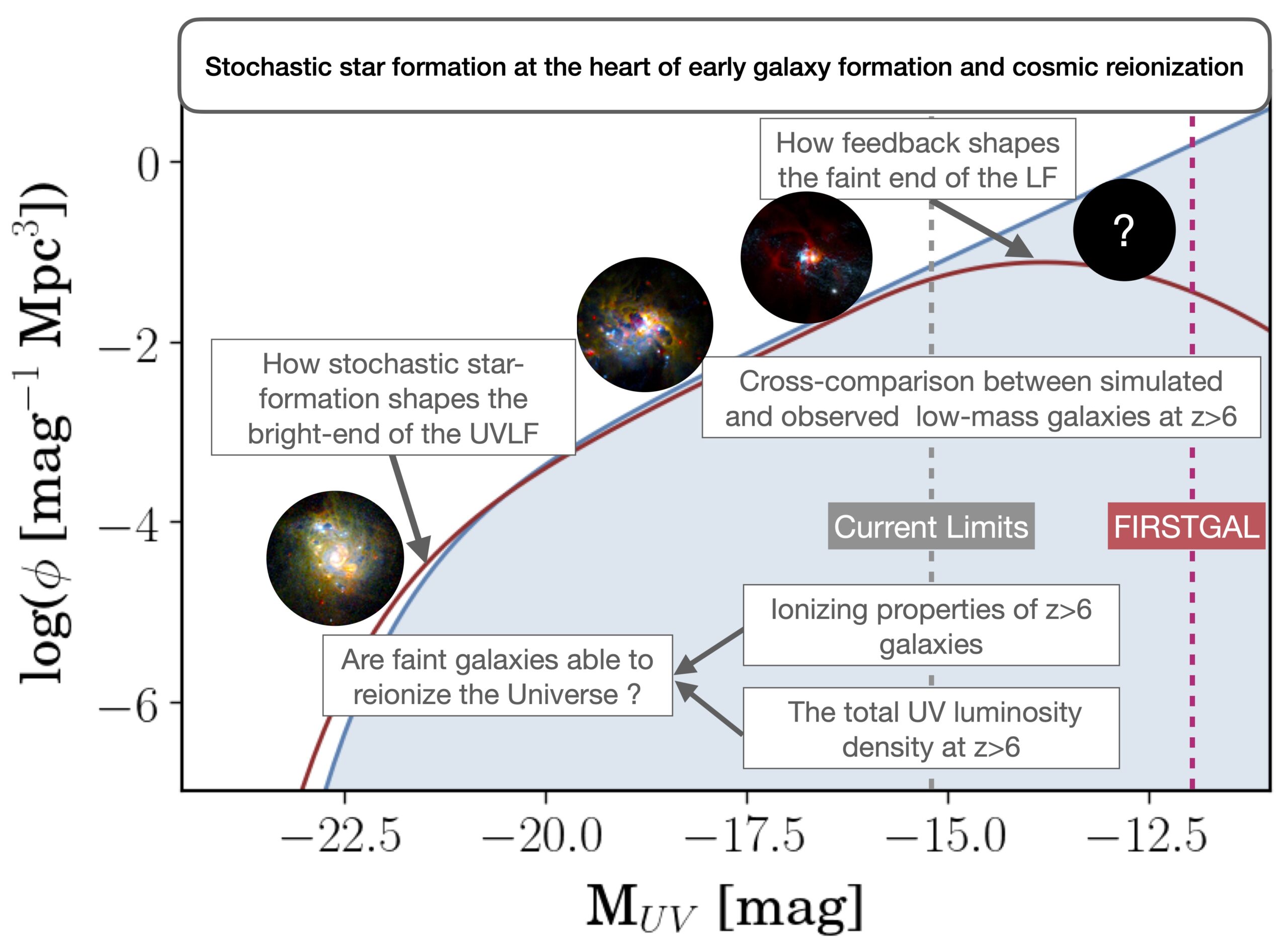
FIRSTGAL (2025–2029) is an ANR-funded research project led by Hakim Atek (IAP) and Joki Rosdahl (CRAL). The project brings together two major efforts: the JWST program GLIMPSE (PI: Atek), which is delivering the deepest images and spectra of the sky, including some of the earliest galaxies in the Universe, and the SPHINX cosmological simulations (PI: Rosdahl), which model how these first galaxies formed and evolved.
Together, these complementary approaches aim to answer some of the biggest open questions in astrophysics:
• How did the first galaxies form?
• How does stochastic star formation shape the appearance and physical properties of early galaxies?
• What sources powered Cosmic Reionization?
At CRAL, postdoctoral researcher Arghyadeep Basu is generating tens of thousands of mock observations from the SPHINX simulations, which will be directly compared with JWST/GLIMPSE spectra to reveal the properties of galaxies forming in the early Universe. New simulations are also being developed to study how cosmic variance, the local UV radiation field, and active galactic nuclei influence the growth and abundance of these primordial galaxies.
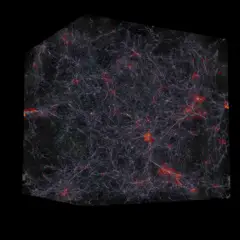
The SPHINX project is coordinated by Joakim Rosdahl (CRAL). The SPHINX suite of cosmological radiative hydrodynamic simulations is designed to study both large-scale reionization and the ionizing radiation escape fraction of thousands of resolved galaxies during the first billion years of the Universe. The volumes studied resolve halos down to their atomic cooling limit and model the interstellar medium with a resolution better than 10 parsecs. The project addresses several scientific objectives related to a better understanding of reionization and serves as a basis for predictions and interpretations for future observations.
Completed projects
The 3DGasFlows project (2017–2023) is an ANR-funded project led by Nicolas Bouché (CRAL). It is dedicated to analyzing the inflow and outflow of gas from galaxies and through the circumgalactic medium (CGM). The project aims to place constraints on both the accretion and ejection of matter by galaxies by developing (i) innovative observations that exploit the unconventional technique of background quasars, using data from MUSE, ALMA, NOEMA, and HST; and (ii) state-of-the-art radiative-hydrodynamic simulations of galaxy formation.
The CALENDS (Clusters And LENsing Distant Sources) project is funded by an ERC Starting Grant and coordinated by Johan Richard (CRAL). This project is dedicated to the analysis of observational data in lensing cluster fields. The CALENDS team analyzes large multi-wavelength datasets, obtained or planned for lensing clusters and distant lensed galaxies using multiple observatories (HST, Spitzer, Herschel, MUSE/ESO-VLT, KMOS/ESO-VLT, ALMA). The goal is to study the physical properties of these galaxies (both resolved and unresolved properties) in comparison to larger samples observed in empty fields.
The MUSICOS project is funded by an ERC Advanced Grant and coordinated by Roland Bacon (CRAL). It is dedicated to visualizing the deep reaches of the universe and observing intergalactic and circumgalactic gases using MUSE/VLT-ESO, an instrument designed and built by a European consortium led by CRAL, with Roland Bacon as the principal investigator.
The POPSYCLE project (2019–2023), funded by the ANR, is led at CRAL by Philippe Prugniel. Its goal is to develop the next generation of stellar population models, which are necessary for analyzing data from EUCLID and the JWST. The precision of spectroscopic and photometric data on galaxies (and star clusters) has improved so much that the models currently used to determine galaxy masses, as well as the history of their chemical evolution and star formation, are no longer sufficient. This project will identify certain stellar physical processes to incorporate them into the new population models.
These models themselves use the “X-Shooter Stellar Library” (XSL), the development of which is a major focus of the team’s work. This “library” of stellar spectra uses observations obtained with ESO’s VLT; it represents a turning point in the history of population modeling because (i) it provides consistent spectral coverage from the optical UV to the near-infrared, and (ii) its spectral resolution is suited to the instruments that will be used in the coming decade. Current developments focus on combining XSL with synthetic spectra of stellar atmospheres, in order to represent both the first galaxies (distant universe) and those of the local universe.
News
-
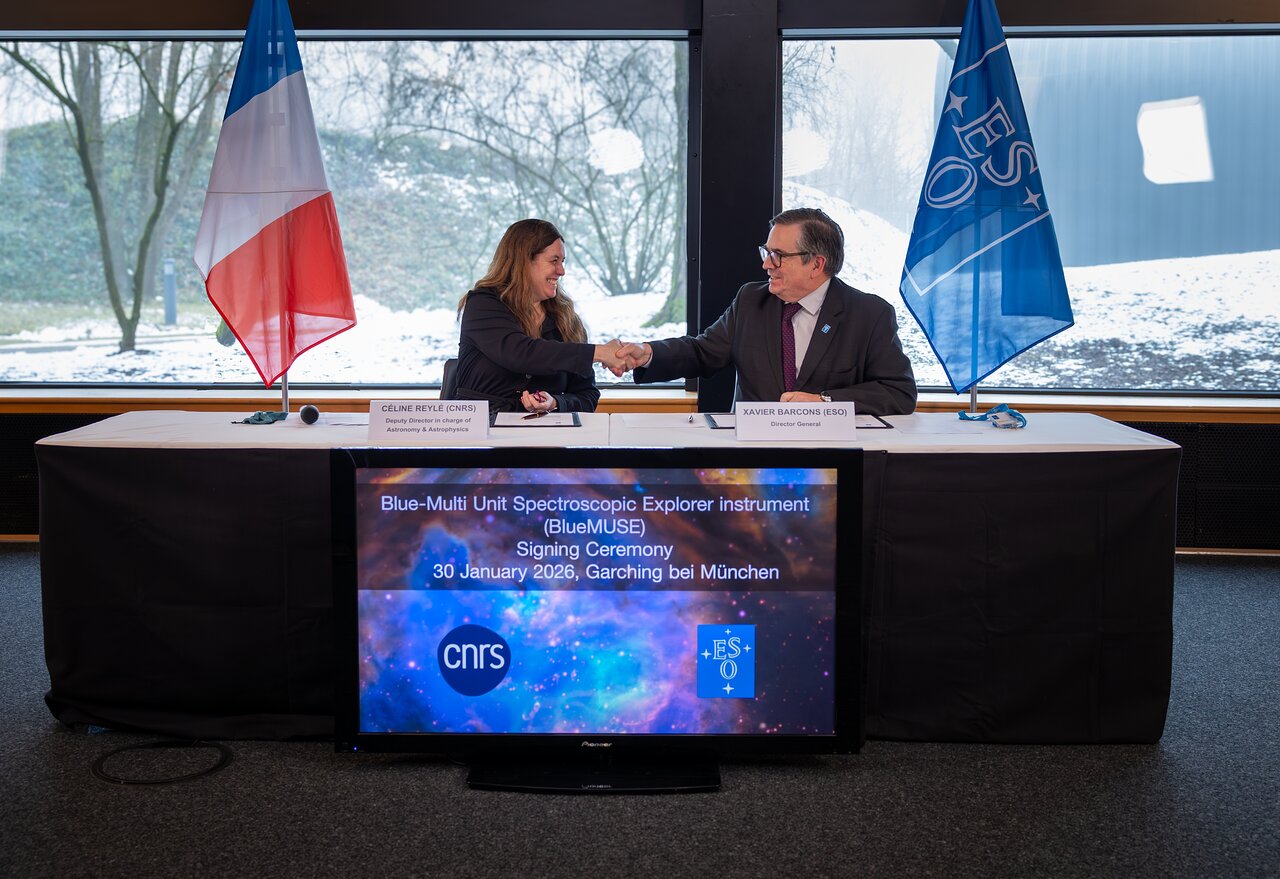
30 January 2026
ESO Signs Contract for BlueMUSE, a New Instrument for the VLT
-
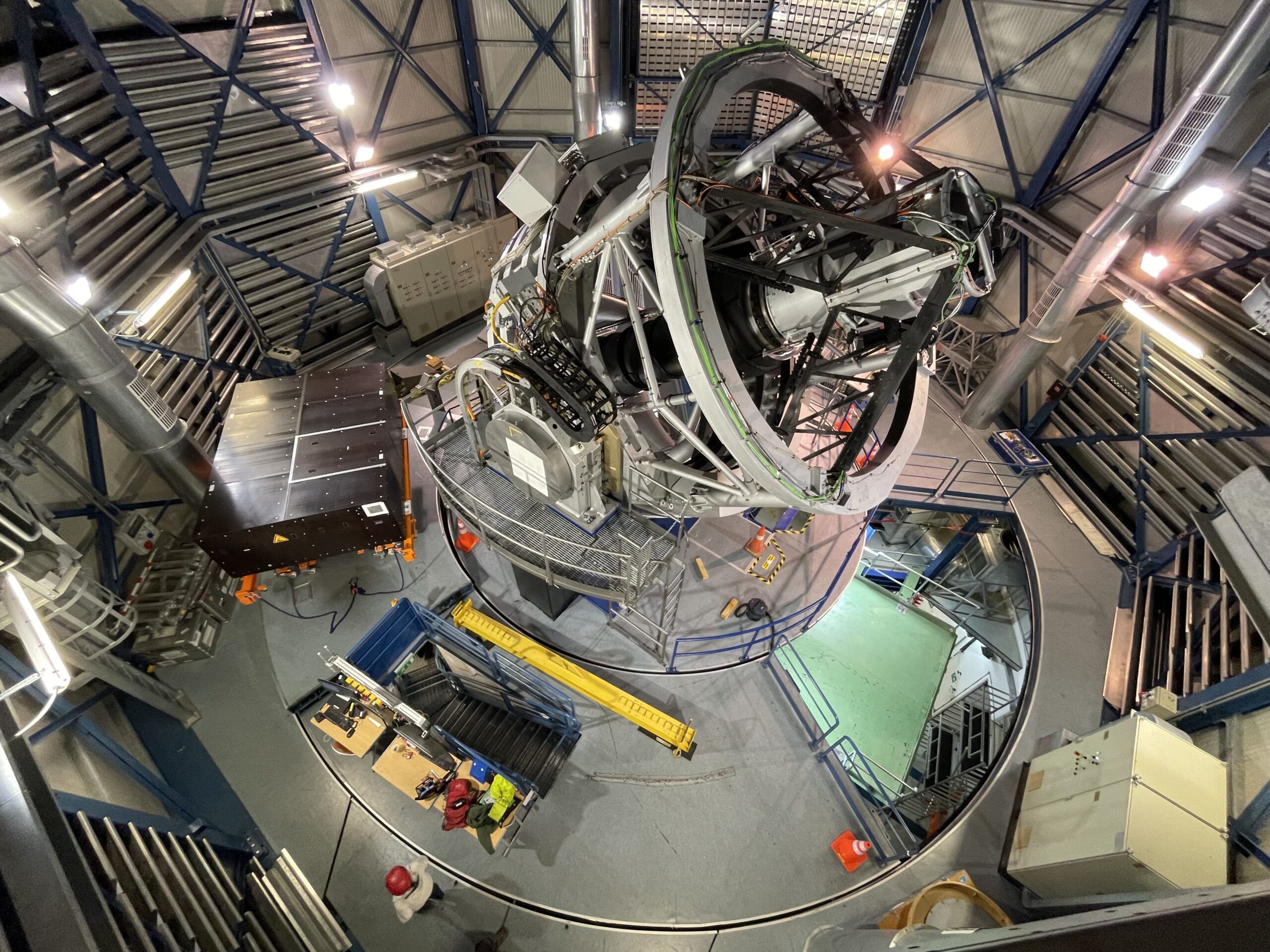
21 October 2025
First light for 4MOST, the next-generation cosmograph
-
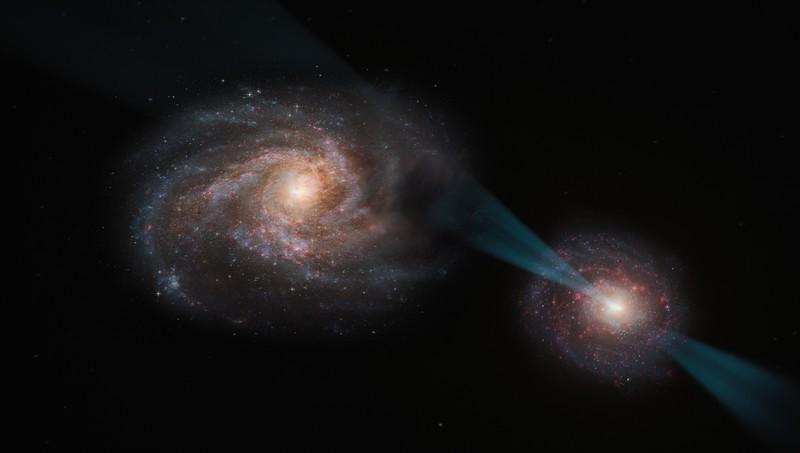
29 June 2025
ALMA observes a cosmic battle 11 billion light-years away
-
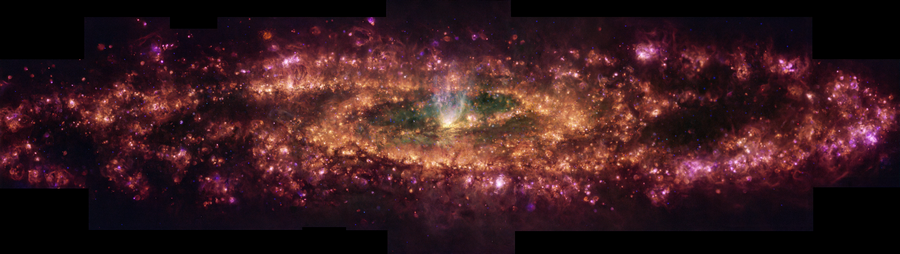
29 June 2025
Astronomers have produced the most detailed multicolor image of a galaxy ever obtained